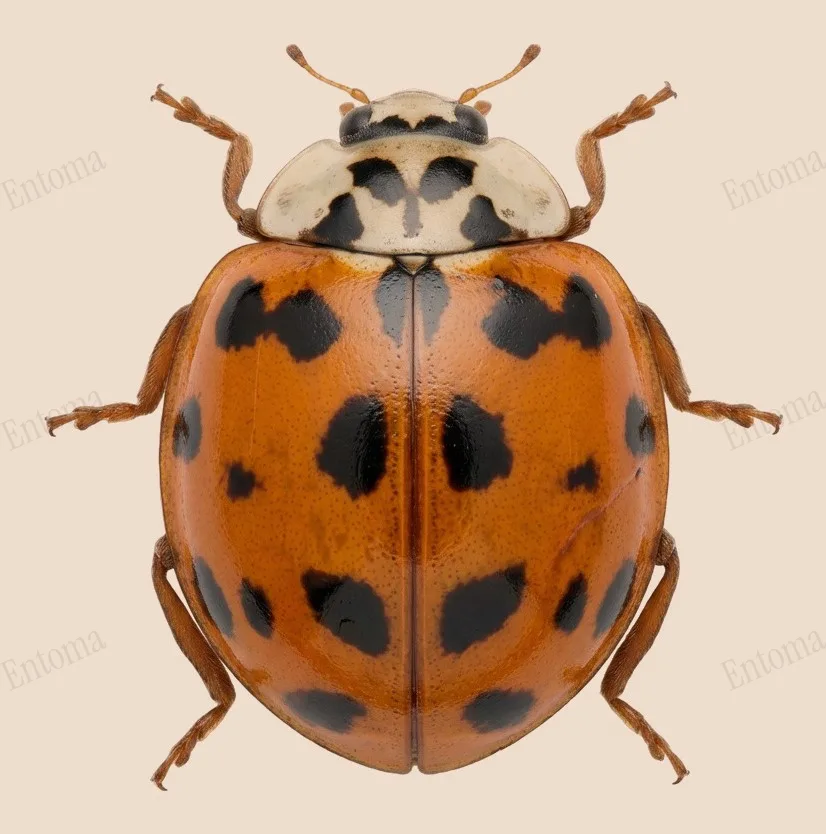
Harlequin ladybird
It was brought to Europe to eat greenhouse aphids and has become one of the most common ladybirds in many areas, out-competing native species for prey.
| Where | Gardens, parks, lime and sycamore trees, house walls in autumn |
|---|---|
| Size | 5.5 to 8.5 mm |
| When | March to November |
The pattern varies wildly: orange with up to 21 spots, black with two or more red spots, and many forms in between. The white pronotum with a black M or W mark is the most reliable sign.
In autumn large groups gather on sunny walls and slip into houses to spend the winter. Handled, it releases a bitter yellow fluid that can stain.
It is a voracious predator that feeds mainly on aphids and scale insects, but it also eats the eggs of other ladybirds. For this reason it is seen as a threat to native ladybirds in the places it has invaded. The legs are reddish brown, and the beetle is larger and more domed than most native species.
Traits
Habitat
Garden
Colour
Red, Black
Active
Day
To people
Harmless; may nip and leave a yellow stain
Activity through the year
Often confused with
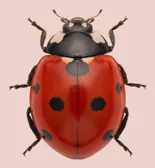
The seven-spot is always red with seven black spots, and its legs are black.
Read more in the guides
Harlequin ladybird or a native one?Invasive insects in the gardenQuestions
Is the Harlequin ladybird dangerous to people?
Harmless; may nip and leave a yellow stain.
When can you see the Harlequin ladybird?
The Harlequin ladybird can be seen from March to November, by day.
Sources en.wikipedia.orgwildlifetrusts.orgnaturespot.org.uk
Plate retouched from a museum specimen photo by Tegan Von Der Heyde, University of Kansas Biodiversity Institute, CC BY 4.0, GBIF Licence
Report a mistake in this entry
Last updated 2026-10-17. Every entry is checked against published sources.