Variegated lady beetle
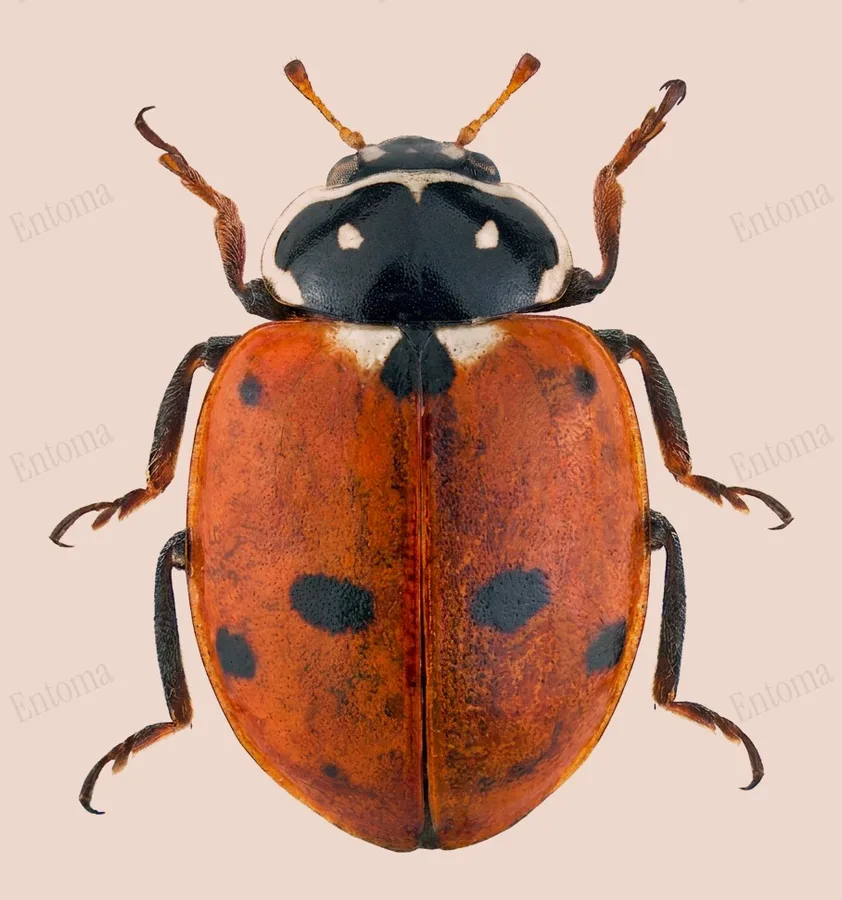
This ladybird can carry up to thirteen black spots on its orange elytra, or occasionally none at all, making spot count useless for identifying it.
| Where | Open grassland, farmland, and gardens |
|---|---|
| Size | 4 to 5.5 mm body length |
| When | April to October |
The variegated lady beetle has an elongated, moderately convex body with orange to red elytra bearing up to thirteen black spots, a black head, and a black pronotum edged in white with a central dark marking.
Both adults and larvae hunt aphids on grasses, crops, and garden plants through the warmer months, making the species a valued natural pest control agent.
Traits
Habitat
Grassland
Colour
Orange, Black, White
Active
Day
To people
Harmless to handle; a natural predator of aphids on crops and garden plants.
Activity through the year
Often confused with
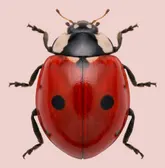
Overlaps in size at 3.5 to 5.5 mm, but typically shows a white pronotum marked in black and only two black spots on red elytra, rather than the variegated ladybird's black, white-edged pronotum.
Questions
Is the Variegated lady beetle dangerous to people?
Harmless to handle; a natural predator of aphids on crops and garden plants.
When can you see the Variegated lady beetle?
The Variegated lady beetle can be seen from April to October, by day.
Plate retouched from a photo by Udo Schmidt from Deutschland, CC BY‑SA 2.0, Wikimedia Commons Licence
The plate on this page is shared under the same licence as its source, CC BY-SA.
Report a mistake in this entry
Last updated 2026-09-26. Every entry is checked against published sources.