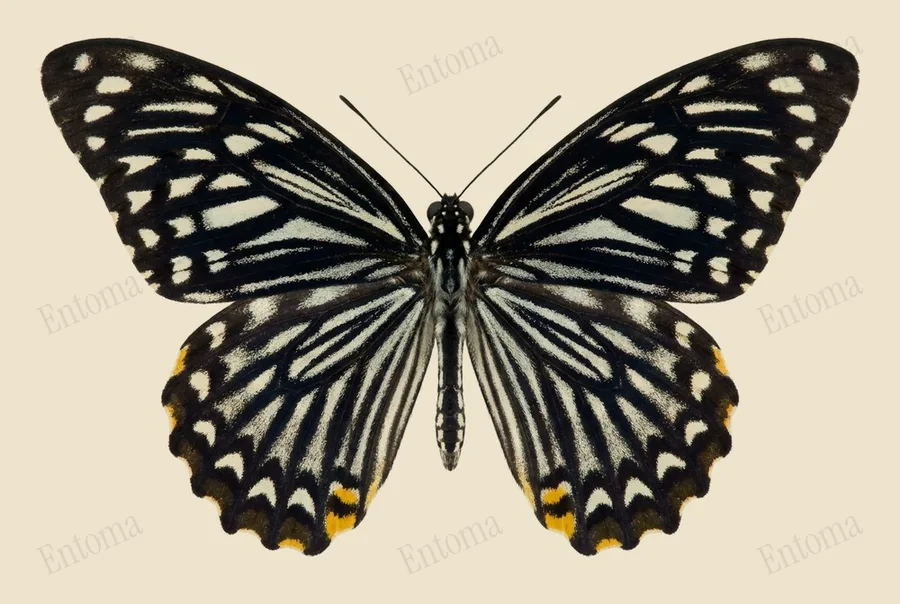
Common mime swallowtail
This swallowtail mimics two unrelated, distasteful butterflies so closely that it is often mistaken for either one, yet it alone keeps a small tail on each hindwing.
| Where | Hill forests, streams and gardens |
|---|---|
| Size | 108 to 121 mm wingspan |
| When | January to December |
The Common mime swallowtail is velvety black or dark brown with white spots and streaks, appearing in two distinct forms, one resembling the Common crow and the other the Blue tiger. Its pupa is disguised as a broken twig, attached along its length rather than at a single point.
Adults fly with an unhurried, fluttering wingbeat through hill forest, mud-puddling at damp ground and basking with wings spread. Caterpillars feed mainly on cinnamon and other laurel family trees.
Traits
Habitat
Woodland
Colour
Black, Brown, White
Active
Day
To people
Does not sting or bite; puddles at damp ground and can be seen basking with its wings open.
Activity through the year
Often confused with
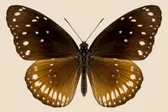
Common crow lacks any tail on the hindwing, unlike the Common mime swallowtail, which keeps a small tail even in its crow-mimicking form.
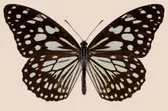
Blue tiger has translucent pale blue-white wing patches and no hindwing tail, unlike the tailed, more opaque hindwing of the mimicking form of the Common mime swallowtail.
Questions
Is the Common mime swallowtail dangerous to people?
Does not sting or bite; puddles at damp ground and can be seen basking with its wings open.
When can you see the Common mime swallowtail?
The Common mime swallowtail can be seen from January to December, by day.
Plate retouched from a photo by Renjith Jacob Mathews, CC BY 4.0, iNaturalist Licence
Report a mistake in this entry
Butterflies and moths›Swallowtails›Papilio
Last updated 2026-09-27. Every entry is checked against published sources.