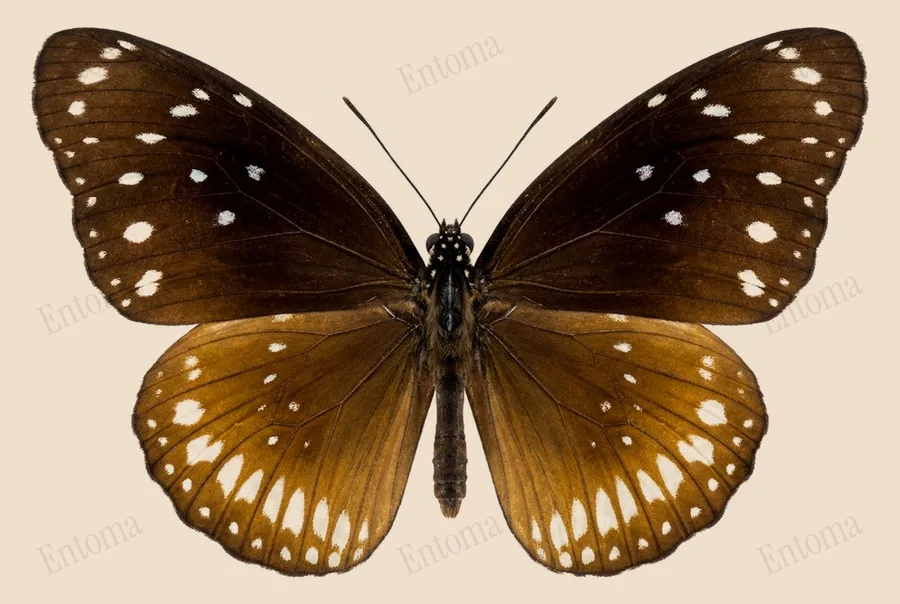
Common crow
The Common crow stores bitter toxins from its caterpillar diet so effectively that predators release it unharmed after a single taste.
| Where | Forests, gardens and open scrub |
|---|---|
| Size | 85 to 95 mm wingspan |
| When | January to December |
The Common crow is a glossy blackish brown butterfly with rows of white spots along both wings, brighter and more contrasting on the underside. Males carry a single velvety black scent patch near the inner edge of the hindwing upperside, hidden when the wings are closed at rest.
Caterpillars feed on fig trees, oleander and other latex bearing plants, storing bitter compounds that make both caterpillar and adult unpleasant to predators. Adults fly with a slow, gliding wingbeat and often gather at damp ground to drink minerals.
Traits
Habitat
Woodland
Colour
Black, White, Brown
Active
Day
To people
Mild
Safe to handle; distasteful and mildly toxic to predators that eat it, from bitter compounds stored since the caterpillar stage.
Activity through the year
Often confused with
The row of white spots follows the wing edge in the Double-branded crow but cuts straight across in the Common crow, and males of the Double-branded crow show two black scent patches on the hindwing instead of one.
Questions
Is the Common crow dangerous to people?
Mild. Safe to handle; distasteful and mildly toxic to predators that eat it, from bitter compounds stored since the caterpillar stage.
When can you see the Common crow?
The Common crow can be seen from January to December, by day.
Plate retouched from a museum specimen photo by Swiss Natural History Collections - SwissNatColl, CC BY 4.0, GBIF Licence
Report a mistake in this entry
Butterflies and moths›Brush-footed butterflies›Euploea
Last updated 2026-09-27. Every entry is checked against published sources.