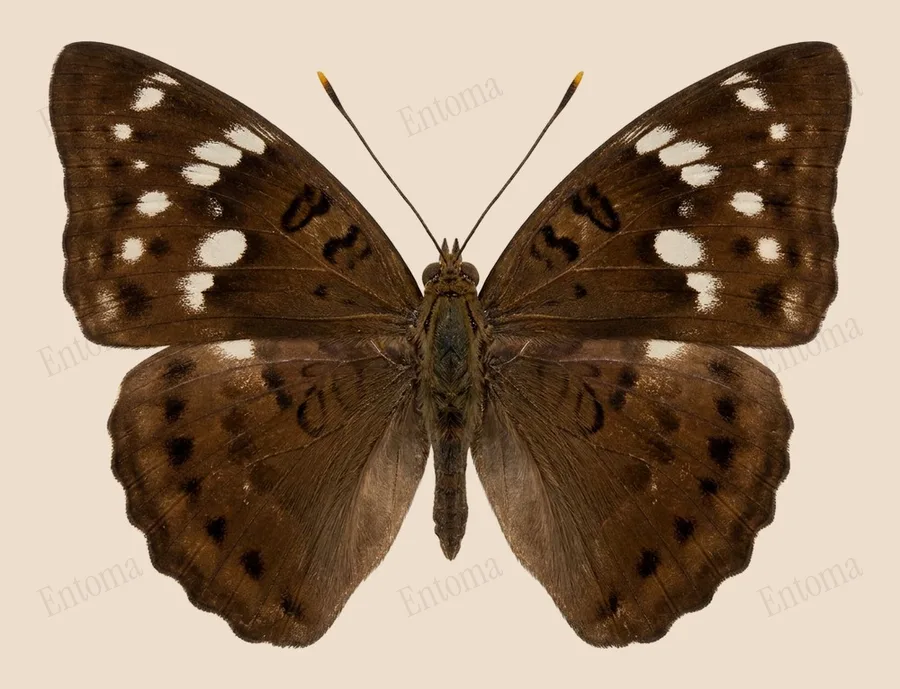
Common baron
Its bright green proboscis stands out against otherwise dull brown wings, and adults return to the same perch on a favourite tree day after day.
| Where | Orchards, wasteland and urban edges |
|---|---|
| Size | 50 to 79 mm wingspan |
| When | January to December |
The Common baron is dark brown above with an obscure, broad post-discal band and small white spots near the forewing tip, larger and more prominent in the paler, larger females. The underside is paler still, with a row of black spots near the margin and a notably lime green proboscis.
Caterpillars feed on mango and cashew trees along with mulberry and other scattered hosts, and adult males hold territories at low altitude, often around orchards, wasteland and urban edges where mango has been planted.
Traits
Habitat
Farmland
Colour
Brown, White
Active
Day
To people
Perches on the same tree each day; safe to touch.
Activity through the year
Often confused with

Males are rich velvety black with a broad bright blue marginal border, quite unlike the plain dark brown upperside of the Common baron.
Questions
Is the Common baron dangerous to people?
Perches on the same tree each day; safe to touch.
When can you see the Common baron?
The Common baron can be seen from January to December, by day.
Plate retouched from a museum specimen photo by Lee Kong Chian Natural History Museum, National University of Singapore, CC BY 4.0, GBIF Licence
Report a mistake in this entry
Butterflies and moths›Brush-footed butterflies›Euthalia
Last updated 2026-09-27. Every entry is checked against published sources.