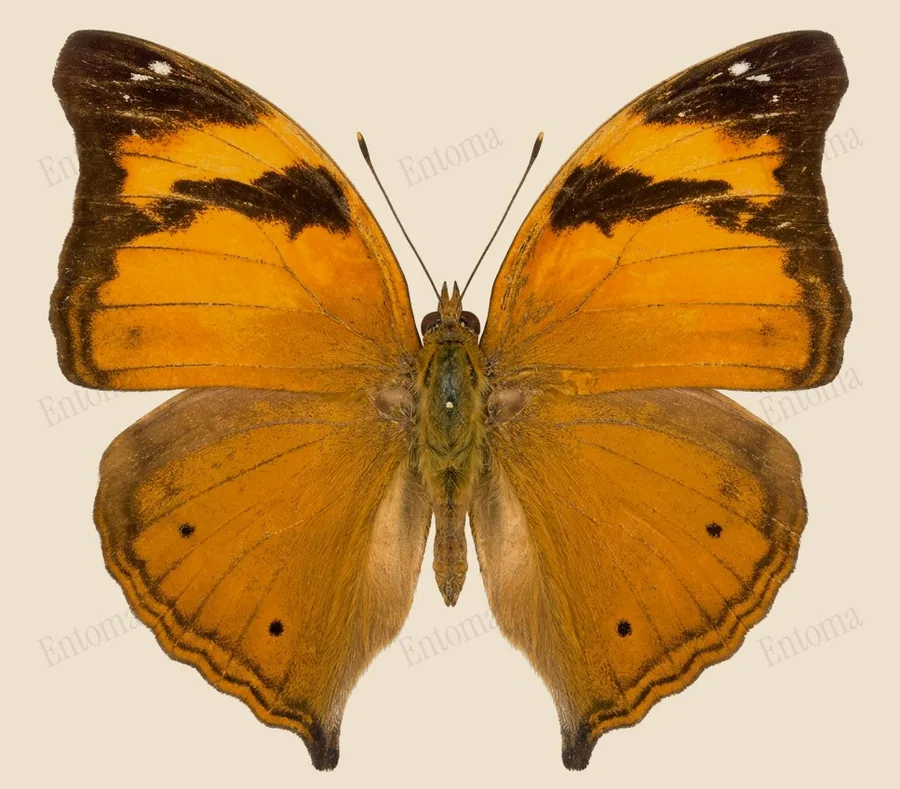
Autumn leaf
When it closes its wings, this butterfly's underside mimics a dead leaf so closely that its markings even include pale patches resembling mould and leaf galls.
| Where | Forest clearings, wastelands and gardens |
|---|---|
| Size | 70 to 85 mm wingspan |
| When | January to December |
Above, the wings are orange brown with the forewing tip broadly blackened and marked with four or five small white spots. The closed wings are grey brown and leaf shaped, with a short tail at the hindwing that resembles a leaf stalk.
Caterpillars feed on low Acanthaceae plants such as Asystasia gangetica, and the fast flying adults are often seen puddling on damp ground or visiting flowers, in forest clearings as readily as in disturbed ground and gardens.
Traits
Habitat
Woodland
Colour
Orange, Brown, Black
Active
Day
To people
Does not bite or sting; harmless to people and often approachable while puddling on damp ground.
Activity through the year
Often confused with
The Orange oakleaf has a more sharply hooked forewing tip and a blue-violet flush on the upperside, while the Autumn leaf's forewing tip is only broadly blackened, without a hook.
Questions
Is the Autumn leaf dangerous to people?
Does not bite or sting; harmless to people and often approachable while puddling on damp ground.
When can you see the Autumn leaf?
The Autumn leaf can be seen from January to December, by day.
Plate retouched from a museum specimen photo by Swiss Natural History Collections - SwissNatColl, CC BY 4.0, GBIF Licence
Report a mistake in this entry
Butterflies and moths›Brush-footed butterflies›Doleschallia
Last updated 2026-09-27. Every entry is checked against published sources.