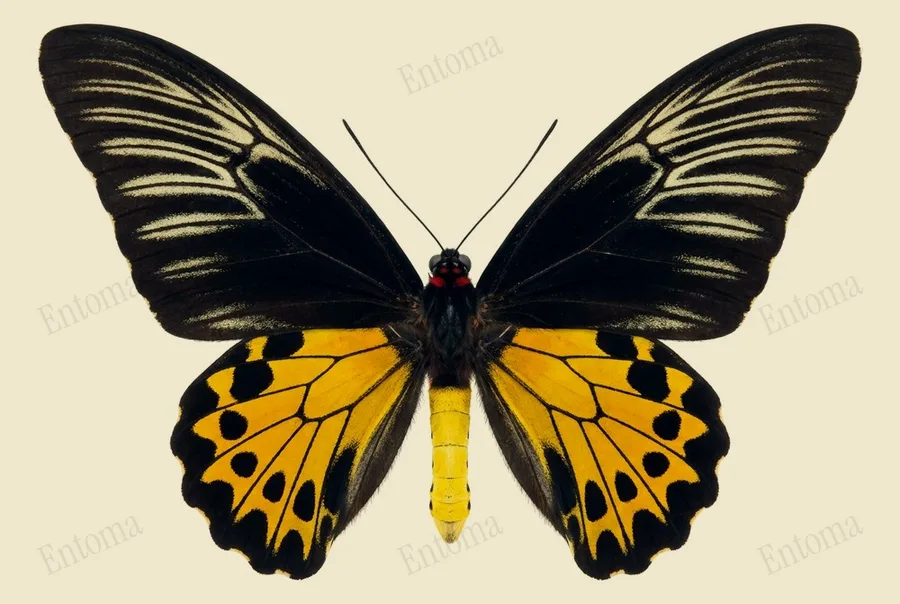
Common birdwing
Its caterpillars feed only on toxic pipevines, and the black and gold adults carry the same poison, making them distasteful for birds to eat.
| Where | Forests, forest edges and gardens |
|---|---|
| Size | 120 to 170 mm wingspan |
| When | January to December |
The common birdwing is a very large butterfly with black forewings and golden yellow hindwings crossed by black veins, a black head and thorax, and a light brown abdomen with a yellow underside. In flight the large forewings beat rapidly while the hindwings stay comparatively still, giving an almost bird like impression.
Caterpillars feed exclusively on Aristolochia and Thottea vines that contain aristolochic acids, and can evert an orange defensive organ behind the head when disturbed. Both larvae and adults remain distasteful to predatory birds, which is thought to explain the butterfly's bold black and gold colouring.
Traits
Habitat
Woodland
Colour
Black, Yellow, Brown
Active
Day
To people
Mild
Distasteful to predatory birds because of toxins carried from its host plants; not known to harm people directly.
Activity through the year
Often confused with
Males show fine black scale peppering along the edge of the golden hindwing patch near its rear corner, a marking absent on the common birdwing; females of this species also carry a small yellow spot breaking up the black patch near the same corner.
Questions
Is the Common birdwing dangerous to people?
Mild. Distasteful to predatory birds because of toxins carried from its host plants; not known to harm people directly.
When can you see the Common birdwing?
The Common birdwing can be seen from January to December, by day.
Plate retouched from a museum specimen photo by Naturalis Biodiversity Center, CC0, GBIF Licence
Report a mistake in this entry
Butterflies and moths›Swallowtails›Troides
Last updated 2026-09-27. Every entry is checked against published sources.