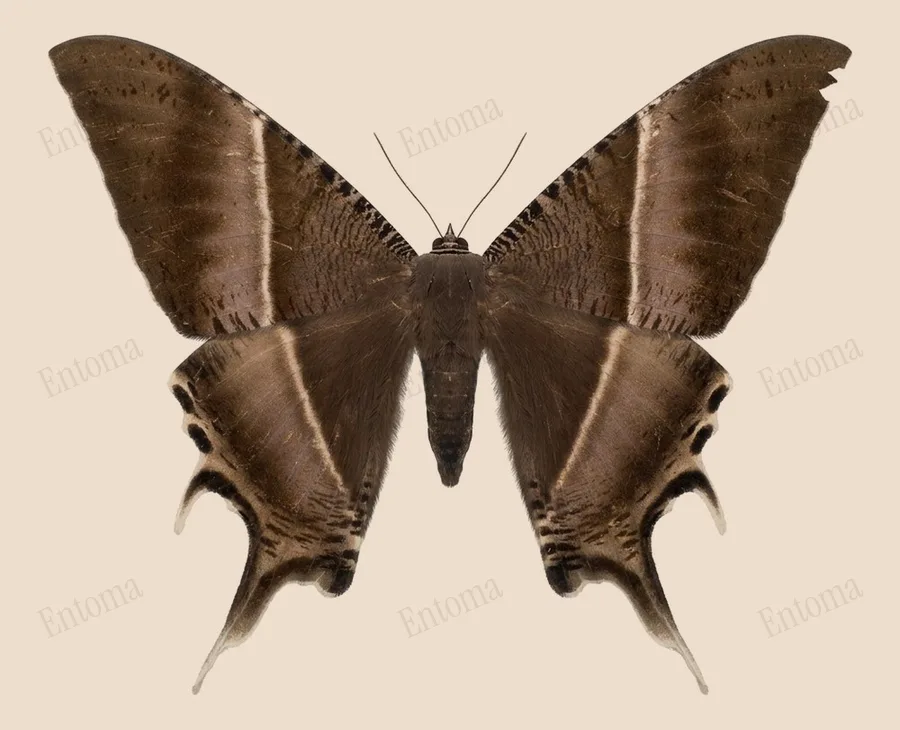
Tropical swallowtail moth
This moth forages both by day and after dark, and its caterpillars can strip whole canopy trees bare during mass emergences that draw thousands into brightly lit towns.
| Where | Lowland and montane rainforest |
|---|---|
| Size | 43 to 70 mm forewing length |
| When | January to December |
This very large moth has grey brown wings crossed by a pale band, with a paler zone just beyond the band and darker fine streaks nearer the wing edge. The long, swallow tailed hindwings are tipped with white.
Caterpillars feed on Endospermum trees and can occur in huge numbers, defoliating host trees before descending on silk threads to pupate in the leaf litter below, with adults emerging in a mass a few months later.
Traits
Habitat
Woodland
Colour
Black, White, Grey
Active
Day and night
To people
Does not bite or sting; a large, harmless moth often attracted to lights in towns during mass emergences.
Activity through the year
Often confused with
Lyssa menoetius lacks the darker fine streaks at the forewing base found in this species, and its paler zone beyond the white band is less distinct.
Questions
Is the Tropical swallowtail moth dangerous to people?
Does not bite or sting; a large, harmless moth often attracted to lights in towns during mass emergences.
When can you see the Tropical swallowtail moth?
The Tropical swallowtail moth can be seen from January to December, by day and at night.
Plate retouched from a photo by dhfischer, CC BY 4.0, iNaturalist Licence
Report a mistake in this entry
Butterflies and moths›Uraniidae›Lyssa
Last updated 2026-09-27. Every entry is checked against published sources.