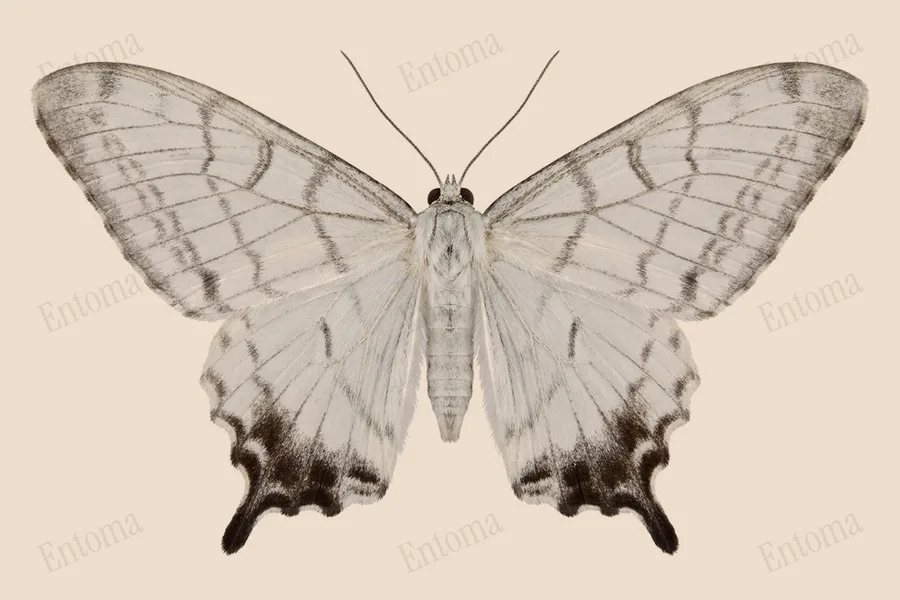
Grey swallowtail moth
This moth's white wings are finely striated with grey, crossed by several oblique bands, and a small black spot marks the base of the short pointed hindwing tail.
| Where | Lowland and hill forests |
|---|---|
| Size | 42 to 50 mm wingspan |
| When | May to December |
The Grey swallowtail moth has a white head, thorax, abdomen and wings, all finely striated with grey, and several faint oblique bands cross the wing surface. A thin dark marginal line runs along the edge, with a small black spot at the base of the hindwing's short tail.
It is a member of the Uraniidae, a family that includes some of the most brightly coloured day-flying moths, though members of this genus are patterned in muted white and grey. It ranges widely across forested parts of South and Southeast Asia, from India and Sri Lanka to Sulawesi.
Traits
Habitat
Woodland
Colour
White, Grey
Active
Night
To people
Rests with wings flat and is not aggressive; safe to observe up close.
Activity through the year
Often confused with
Much larger at 60 to 76 mm wingspan against the Grey swallowtail moth's 42 to 50 mm, with six broad oblique bands crossing the forewing rather than the finer, more numerous striations of the smaller species.
Questions
Is the Grey swallowtail moth dangerous to people?
Rests with wings flat and is not aggressive; safe to observe up close.
When can you see the Grey swallowtail moth?
The Grey swallowtail moth can be seen from May to December, at night.
Plate retouched from a museum specimen photo by Taiwan Biodiversity Research Institute, CC BY 4.0, GBIF Licence
Report a mistake in this entry
Butterflies and moths›Uraniidae›Micronia
Last updated 2026-09-27. Every entry is checked against published sources.