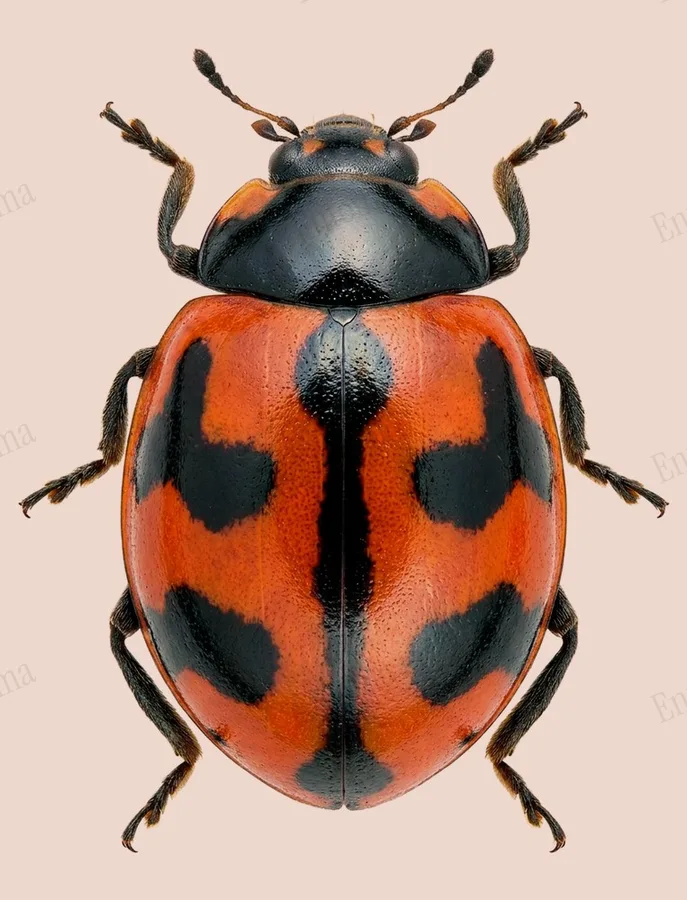
Small transverse ladybird beetle
This ladybird's black markings fuse into a central stripe and two three lobed patches on each wing case, instead of separate round spots.
| Where | Farmland, gardens and grassy fields |
|---|---|
| Size | 4 to 7 mm body length |
| When | January to December |
The Small transverse ladybird has bright orange red wing cases marked with black that runs together into a central stripe flanked by two three lobed patches on each side, rather than separate round spots. The head and underside are black.
Both adults and larvae hunt soft bodied insects such as aphids, leafhoppers, scale insects and psyllids, making the species a useful natural control of crop pests. It is common across farmland, gardens and grassy fields from India through southern and southeastern Asia to Australia.
Traits
Habitat
Farmland
Colour
Red, Orange, Black
Active
Day
To people
Harmless to people; both adults and larvae feed on aphids and other soft bodied crop pests.
Activity through the year
Often confused with
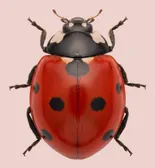
The Seven spot ladybird has seven separate round black spots on red orange wing cases, unlike the Small transverse ladybird's markings, which are fused into a central stripe and side patches.
Questions
Is the Small transverse ladybird beetle dangerous to people?
Harmless to people; both adults and larvae feed on aphids and other soft bodied crop pests.
When can you see the Small transverse ladybird beetle?
The Small transverse ladybird beetle can be seen from January to December, by day.
Plate retouched from a museum specimen photo by Rogers-Davidson, Sally, Museums Victoria, CC0, GBIF Licence
Report a mistake in this entry
Last updated 2026-09-27. Every entry is checked against published sources.