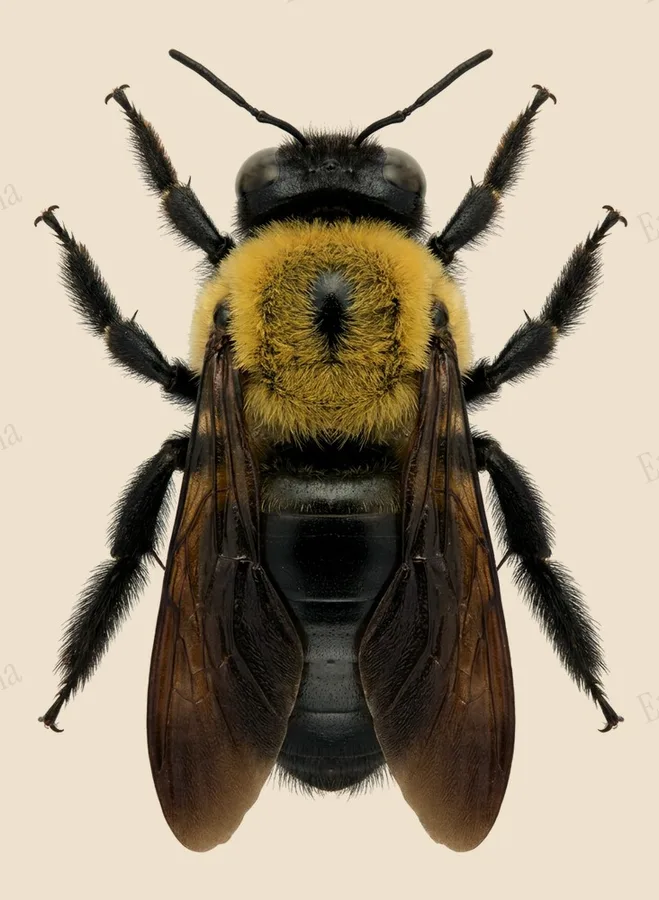
Eastern carpenter bee
Male Eastern Carpenter Bees cannot sting and instead defend territory by hovering aggressively in front of intruders, including people, without ever making contact.
| Where | Gardens, woodland edges and wooden structures |
|---|---|
| Size | 20 to 25 mm body length |
| When | March to October |
Adults are large bees about 20 to 25 millimeters long, with a shiny, almost hairless black abdomen and a thorax covered in yellow hair, a combination that separates them from fuzzy-bodied bumble bees. Males often show a pale patch on the face.
Females chew round tunnels into bare, unpainted wood to raise their brood, reusing and extending old tunnels year after year, which can weaken beams and siding over time even though the bees rarely damage sound structural wood.
Traits
Habitat
Garden
Colour
Black, Yellow
Active
Day
To people
Mild
Females can sting but are docile and rarely do unless directly handled; males cannot sting at all.
Activity through the year
Often confused with
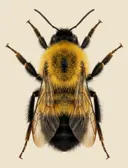
Has a fuzzy, yellow-and-black banded abdomen, unlike the shiny, mostly bare black abdomen of the Eastern Carpenter Bee.
Questions
Is the Eastern carpenter bee dangerous to people?
Mild. Females can sting but are docile and rarely do unless directly handled; males cannot sting at all.
When can you see the Eastern carpenter bee?
The Eastern carpenter bee can be seen from March to October, by day.
Plate retouched from a museum specimen photo by Virginia Tech, Department of Entomology, Virginia Tech Insect Collection, CC0, GBIF Licence
Report a mistake in this entry
Bees, wasps and ants›Bees and bumblebees›Xylocopa
Last updated 2026-09-26. Every entry is checked against published sources.