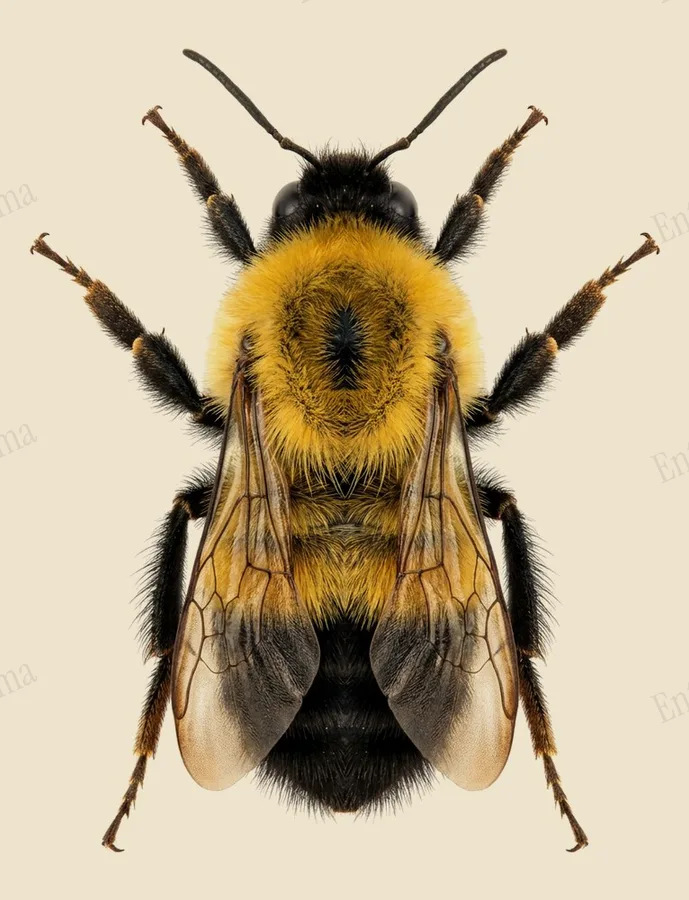
Common eastern bumble bee
Colonies of this bumble bee are reared commercially across North America to pollinate greenhouse tomatoes, since the bees vibrate flowers to shake loose pollen.
| Where | Fields, gardens, farmland and woodland edges |
|---|---|
| Size | 9 to 21 mm body length |
| When | May to October |
Workers are black with a single yellow band on the thorax and often a yellow band near the base of the abdomen, while the rest of the abdomen stays black; queens are noticeably larger than workers, and body length across castes runs from about 9 to 21 millimeters.
Colonies nest underground, often reusing abandoned rodent burrows, and a mature nest can hold several hundred workers by late summer before newly mated queens leave to overwinter alone and start fresh colonies the following spring.
Traits
Habitat
Garden
Colour
Black, Yellow
Active
Day
To people
Mild
Generally docile and non-aggressive; stings are rare and occur mainly when the nest is directly disturbed.
Activity through the year
Often confused with
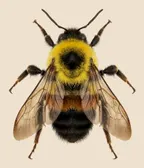
Shows a rust-brown patch on the second abdominal segment, where the Common Eastern bumble bee is plain black beyond its first yellow band.
Questions
Is the Common eastern bumble bee dangerous to people?
Mild. Generally docile and non-aggressive; stings are rare and occur mainly when the nest is directly disturbed.
When can you see the Common eastern bumble bee?
The Common eastern bumble bee can be seen from May to October, by day.
Plate retouched from a museum specimen photo by Virginia Tech, Department of Entomology, Virginia Tech Insect Collection, CC0, GBIF Licence
Report a mistake in this entry
Bees, wasps and ants›Bees and bumblebees›Bombus
Last updated 2026-09-26. Every entry is checked against published sources.