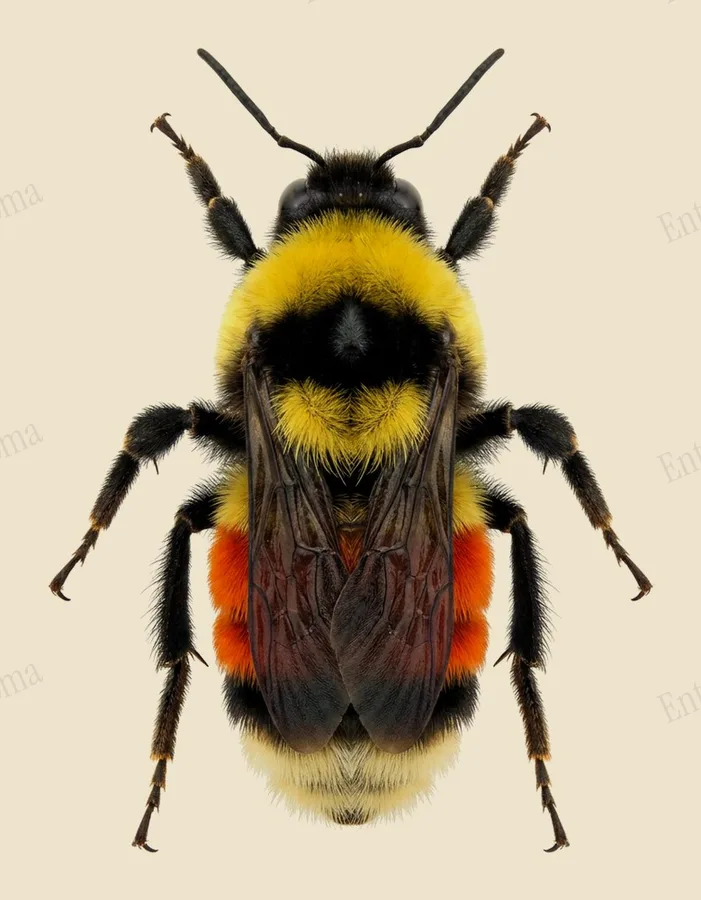
Hunt's bumble bee
Queens of this bumble bee can be nearly twice as long as males, and colonies are founded each spring by a single queen who survived winter underground.
| Where | Prairies, meadows and desert shrubland |
|---|---|
| Size | 9 to 20 mm body length |
| When | April to September |
Hunt's bumble bee has a yellow face and a yellow band across the front and back of the thorax, with the first abdominal segment yellow, the next two segments red to orange, and the rear segments black.
Queens found new colonies alone each spring in old rodent burrows or similar cavities underground, and workers forage on a wide range of flowers, including milkvetch, fleabane, lupine and bluebells, across deserts, prairies and mountain meadows in western North America.
Traits
Habitat
Grassland
Colour
Yellow, Black, Orange
Active
Day
To people
Mild
Females can sting if handled or if the nest is threatened, but this bumble bee is not aggressive and rarely stings without cause.
Activity through the year
Often confused with
The Two-form bumble bee usually shows a black patch across the lower part of the thorax and red hair confined to the middle abdominal segments, while Hunt's bumble bee has yellow covering the front and back of the thorax with only a narrow black band between the wings.
Questions
Is the Hunt's bumble bee dangerous to people?
Mild. Females can sting if handled or if the nest is threatened, but this bumble bee is not aggressive and rarely stings without cause.
When can you see the Hunt's bumble bee?
The Hunt's bumble bee can be seen from April to September, by day.
Plate retouched from a museum specimen photo by AJ Thomas, Colorado State University, C.P. Gillette Museum of Arthropod Diversity, CC0, GBIF Licence
Report a mistake in this entry
Bees, wasps and ants›Bees and bumblebees›Bombus
Last updated 2026-09-27. Every entry is checked against published sources.