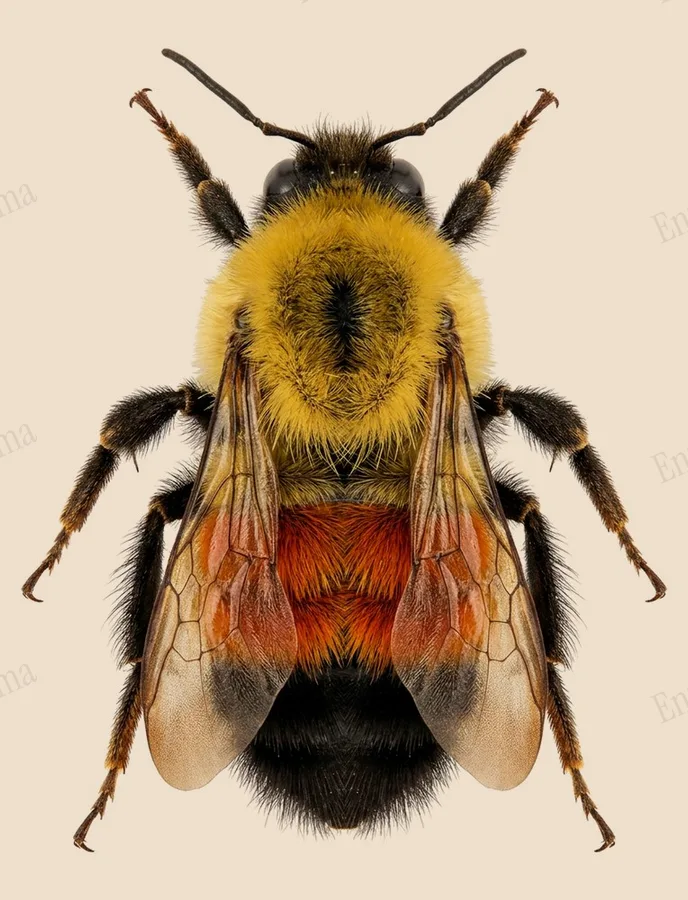
Black-tailed bumble bee
Queens of this bumble bee start new nests as early as February, making it one of the first bumble bees active each year across the West.
| Where | Grassy meadows across western North America |
|---|---|
| Size | 10 to 19 mm body length |
| When | February to August |
The black-tailed bumble bee has a yellow face and a yellow band at the front of the thorax, with the middle abdominal segments red orange in one common form and black in another, and a scutellum that is evenly yellow rather than split by a dark triangle.
Colonies nest underground or in ready-made cavities such as bird houses and building insulation, and queens are among the earliest bumble bees to begin nesting each spring.
Traits
Habitat
Grassland
Colour
Black, Orange, Yellow
Active
Day
To people
Mild
Females can sting but are not aggressive and seldom do so unless the nest is threatened or the bee is trapped; a calm visitor to garden and meadow flowers.
Activity through the year
Often confused with
Has its thoracic hair divided into two patches by a dark triangle at the scutellum, where the black-tailed bumble bee shows an evenly yellow scutellum.
Questions
Is the Black-tailed bumble bee dangerous to people?
Mild. Females can sting but are not aggressive and seldom do so unless the nest is threatened or the bee is trapped; a calm visitor to garden and meadow flowers.
When can you see the Black-tailed bumble bee?
The Black-tailed bumble bee can be seen from February to August, by day.
Plate retouched from a museum specimen photo by University of California Santa Barbara Invertebrate Zoology Collection, Cheadle Center for Biodiversity and Ecological Restoration, CC0, GBIF Licence
Report a mistake in this entry
Bees, wasps and ants›Bees and bumblebees›Bombus
Last updated 2026-09-26. Every entry is checked against published sources.