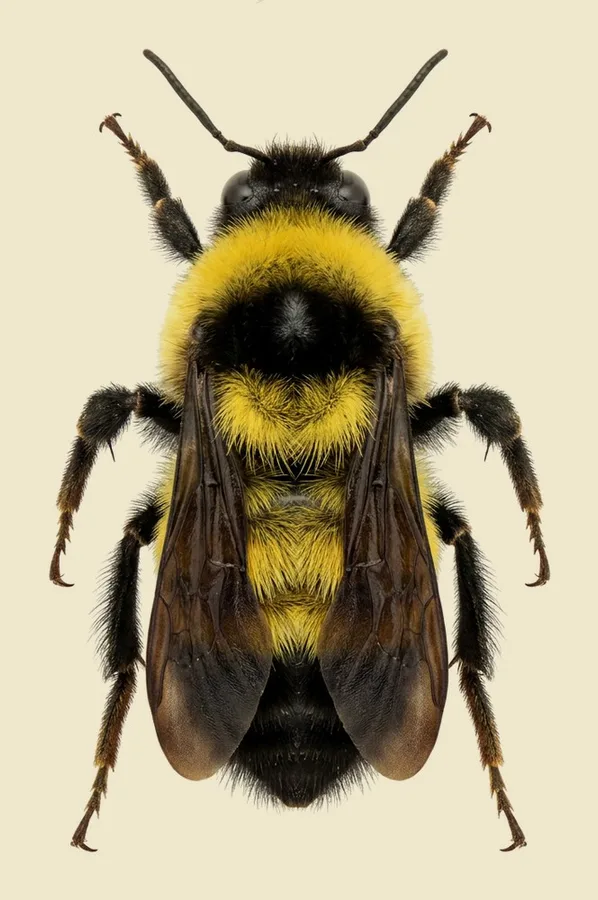
American bumble bee
American bumble bee colonies have declined by roughly 90 percent since the early 2000s, turning a once common prairie pollinator into a conservation concern across much of its range.
| Where | Open farmland, prairies and fields |
|---|---|
| Size | 13 to 26 mm body length |
| When | April to October |
The American bumble bee is a large, short-haired bumble bee with mostly yellow hair on the thorax and abdomen broken by a black band between the wings, and females show little black on the abdomen compared to similar species. Males have larger eyes and slightly more yellow hair.
Colonies nest in tall grass or occasionally underground across farmland, prairies and open fields from the eastern Great Plains to the Atlantic coast, with the cycle running from late winter queens through late season males. Workers forage on a wide range of flowering plants through the growing season.
Traits
Habitat
Farmland
Colour
Black, Yellow
Active
Day
To people
Take care
Not aggressive and rarely notices people, but can sting more than once if handled or if its nest is disturbed.
Activity through the year
Often confused with
Shows two sharply separated black bands, one between the wings and one low on the abdomen, against pale yellow hair, rather than the more evenly yellow haired American bumble bee.
Questions
Is the American bumble bee dangerous to people?
Take care. Not aggressive and rarely notices people, but can sting more than once if handled or if its nest is disturbed.
When can you see the American bumble bee?
The American bumble bee can be seen from April to October, by day.
Plate retouched from a museum specimen photo by Virginia Tech, Department of Entomology, Virginia Tech Insect Collection, CC0, GBIF Licence
Report a mistake in this entry
Bees, wasps and ants›Bees and bumblebees›Bombus
Last updated 2026-09-26. Every entry is checked against published sources.