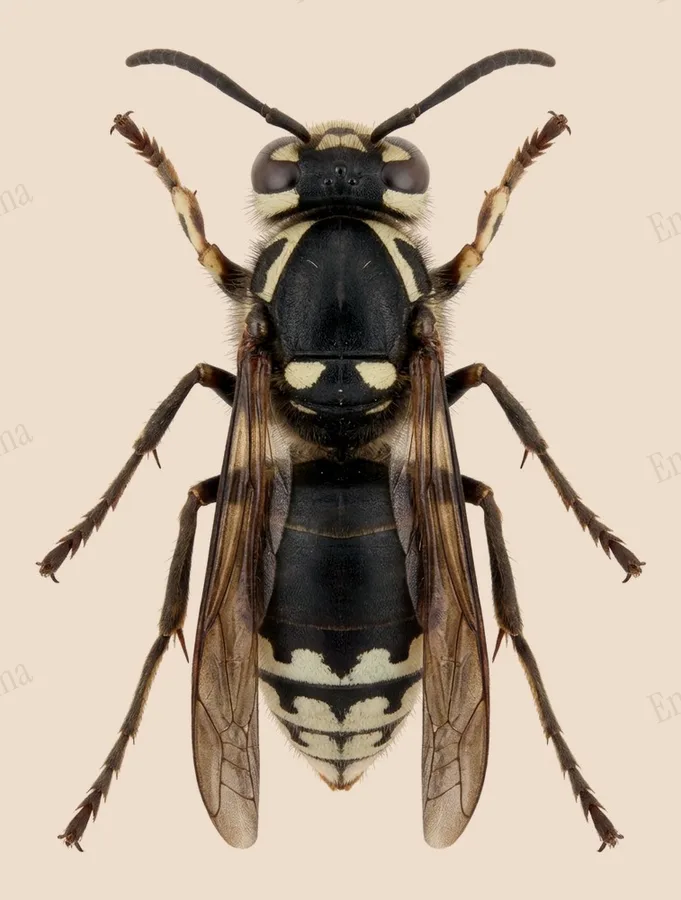
Bald-faced hornet
Colonies of this wasp build a single large paper nest that can hold over 700 workers and grow nearly two feet long by the end of summer.
| Where | Forest edges, gardens and buildings |
|---|---|
| Size | 12 to 20 mm body length |
| When | May to October |
The Bald-faced hornet is a black and white wasp, larger than most yellowjackets, that builds a rounded grey paper nest hanging from trees, shrubs or buildings.
Workers defend the nest aggressively within several feet of it, stinging repeatedly since their stinger is smooth, and colonies can grow to several hundred workers by late summer before dying off in fall.
Traits
Habitat
Garden
Colour
Black, White
Active
Day
To people
Take care
Stings can be repeated and painful, and workers defend the nest aggressively, so nests should be left alone or removed only by a professional.
Activity through the year
Often confused with
Similar nest-building habits, but the aerial yellowjacket is marked with black and yellow rather than the bald-faced hornet's black and white pattern, and it builds a smaller, rounder nest.
Questions
Is the Bald-faced hornet dangerous to people?
Take care. Stings can be repeated and painful, and workers defend the nest aggressively, so nests should be left alone or removed only by a professional.
When can you see the Bald-faced hornet?
The Bald-faced hornet can be seen from May to October, by day.
Plate retouched from a museum specimen photo by University of Texas at Austin, Biodiversity Collections, CC0, GBIF Licence
Report a mistake in this entry
Bees, wasps and ants›Wasps and hornets›Dolichovespula
Last updated 2026-09-26. Every entry is checked against published sources.