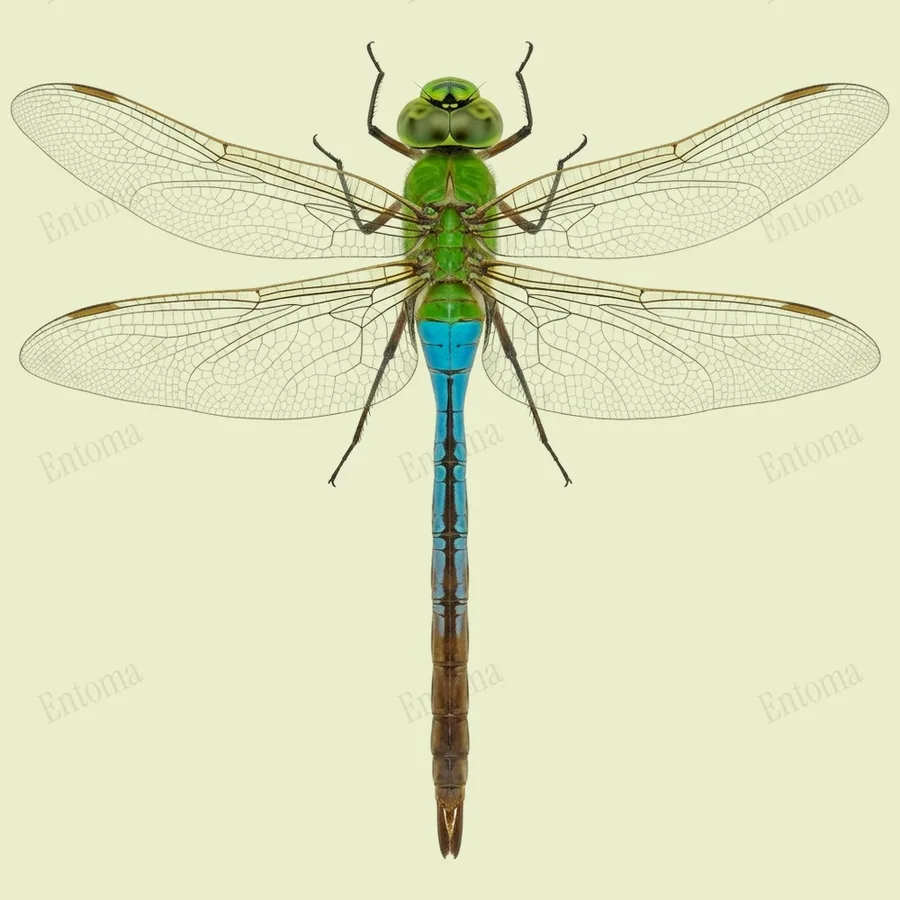
Common green darner
Some green darners migrate hundreds of miles south each fall like monarch butterflies, and isotope tracking confirmed in 2018 that the round trip takes several generations.
| Where | Ponds, lakes and wetlands |
|---|---|
| Size | 70 to 100 mm wingspan |
| When | April to October |
This large dragonfly has a green thorax and a long abdomen that is blue in males and reddish brown in females, with a distinctive bullseye pattern on the forehead visible from above.
Adults breed in ponds, lakes and slow moving water, and many populations migrate south in fall and north again in spring, with tracking studies showing the migration spans several overlapping generations.
Traits
Habitat
Wetland
Colour
Green, Blue
Active
Day
To people
Harmless to people; does not sting or bite and is often watched for its long distance migration.
Activity through the year
Often confused with
Males have a bright red abdomen rather than the blue abdomen of the Common green darner, and females lack the bullseye marking on the forehead.
Questions
Is the Common green darner dangerous to people?
Harmless to people; does not sting or bite and is often watched for its long distance migration.
When can you see the Common green darner?
The Common green darner can be seen from April to October, by day.
Plate retouched from a photo by Andy Deans, CC BY 4.0, iNaturalist Licence
Report a mistake in this entry
Dragonflies and damselflies›Hawkers›Anax
Last updated 2026-09-26. Every entry is checked against published sources.