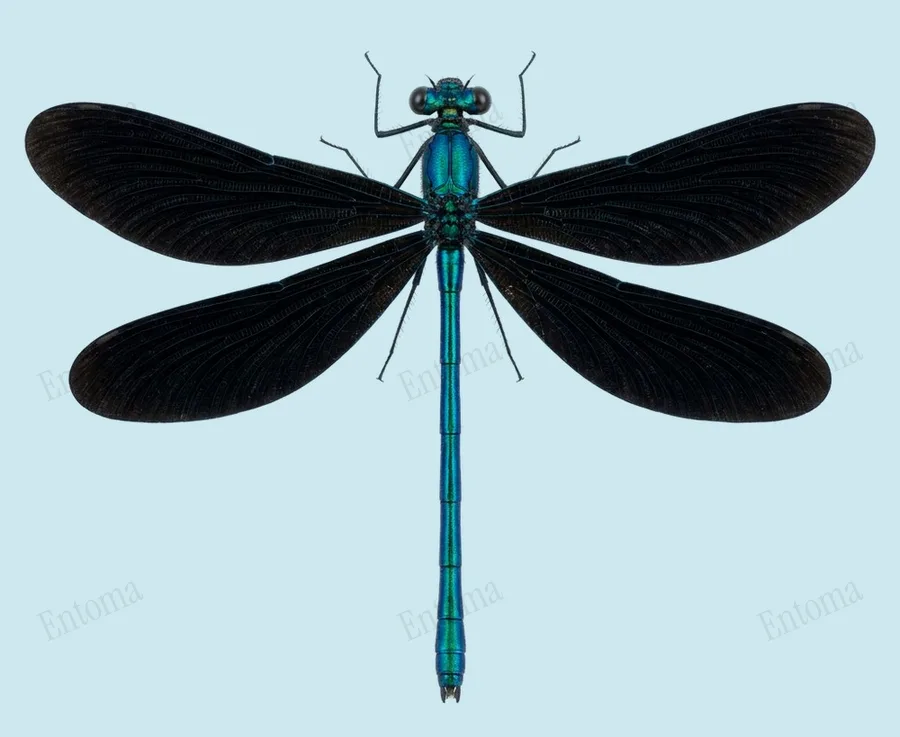
Ebony jewelwing
Unlike every other jewelwing in North America, the ebony jewelwing's wings are completely black from base to tip in both sexes, not just at the tips.
| Where | Wooded streams and shaded rivers |
|---|---|
| Size | 39 to 57 mm body length |
| When | May to August |
Males are metallic blue-green with entirely black wings, while females are a duller bronze-green with smoky brown wings marked by a small white spot near the tip of each one. Both sexes are large, slender damselflies with a slow, fluttering flight low over the water.
Adults are found along shaded, slow-flowing streams and wooded rivers across the eastern United States and southeastern Canada, though they can wander well away from water once mature. Males defend short stretches of stream bank and display to females with a fluttering flight before mating.
Traits
Habitat
Wetland
Colour
Black, Metallic, Green
Active
Day
To people
Does not bite or sting; harmless to handle.
Activity through the year
Often confused with
Only the outer third or less of its wings are black, leaving the base of the wing clear, unlike the fully black wings of the ebony jewelwing.
Questions
Is the Ebony jewelwing dangerous to people?
Does not bite or sting; harmless to handle.
When can you see the Ebony jewelwing?
The Ebony jewelwing can be seen from May to August, by day.
Plate retouched from a photo by good-and-weevil, CC0, iNaturalist Licence
Report a mistake in this entry
Dragonflies and damselflies›Demoiselles›Calopteryx
Last updated 2026-09-26. Every entry is checked against published sources.