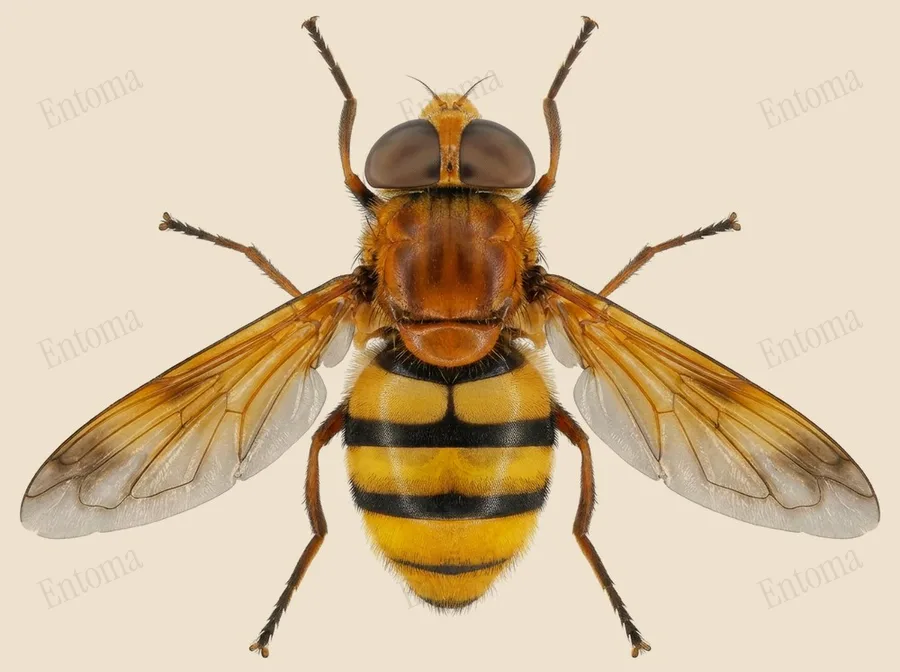
Lesser hornet hoverfly
Its larvae live as parasites inside the nests of hornets and wasps, yet the harmless adult fly only mimics their black and yellow banding for protection.
| Where | Flower meadows, hedgerows and verges |
|---|---|
| Size | 12 to 14 mm body length |
| When | July to September |
The Lesser hornet hoverfly is a large fly, 12 to 14 mm long, with three yellow bands crossing an otherwise black abdomen, closely resembling a small hornet or wasp. Unlike a true wasp it has only one pair of wings and lacks a narrow waist.
Females enter the nests of common wasps and hornets and lay eggs on the paper envelope, and the larvae then develop inside the nest alongside the wasp brood. Adults fly by day from midsummer into autumn, visiting flowers such as yarrow, thistles and buddleja.
Traits
Habitat
Grassland
Colour
Black, Yellow
Active
Day
To people
Harmless to people; its wasp-like bands are for mimicry only, not defense.
Activity through the year
Often confused with
Larger at 18 to 25 mm, with chestnut coloring on the thorax and first abdominal segment that the Lesser hornet hoverfly lacks.
Questions
Is the Lesser hornet hoverfly dangerous to people?
Harmless to people; its wasp-like bands are for mimicry only, not defense.
When can you see the Lesser hornet hoverfly?
The Lesser hornet hoverfly can be seen from July to September, by day.
Plate retouched from a museum specimen photo by Kåre Solheim, Norwegian Biodiversity Information Centre, CC BY 4.0, GBIF Licence
Report a mistake in this entry
Last updated 2026-09-26. Every entry is checked against published sources.