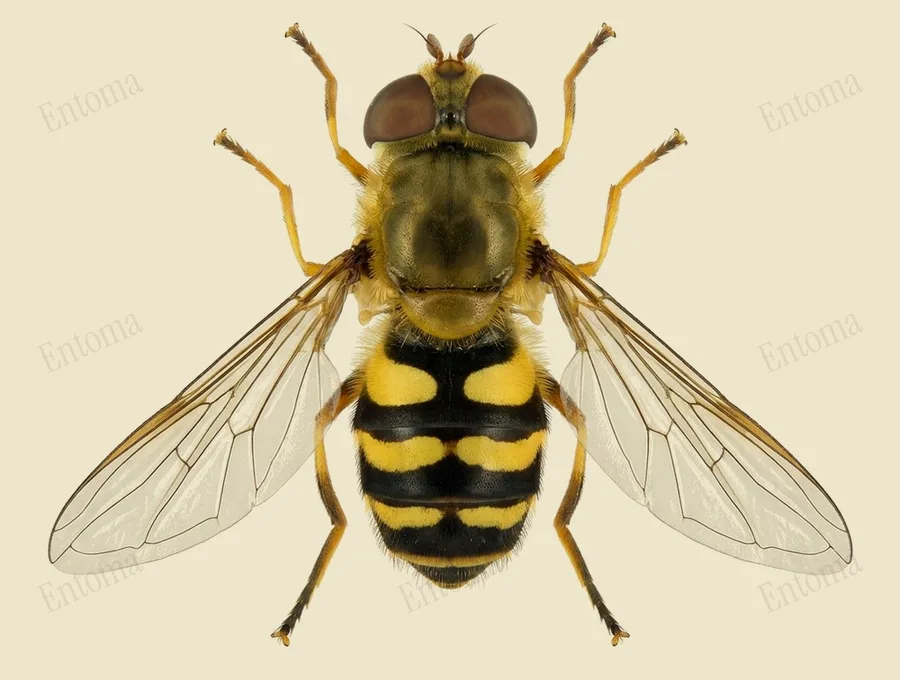
Common flower fly
Females of this hoverfly have entirely yellow hind legs, the single feature separating them from an almost identical, equally common relative that shares the same gardens.
| Where | Gardens, hedgerows and woodland edges |
|---|---|
| Size | 9 to 11 mm body length |
| When | April to October |
This hoverfly has a black abdomen crossed by broad yellow bands, giving it a moustache like banded pattern. Males have eyes that meet at the top of the head while the eyes of females are widely separated, and females are told apart from a near identical relative by their all yellow hind legs.
Larvae are aphid predators that hunt among leaves and stems in gardens and hedgerows, while adults feed on nectar and pollen at flowers from spring through autumn, producing several generations each year.
Traits
Habitat
Garden
Colour
Black, Yellow
Active
Day
To people
Feeds on nectar and pollen and does not bite or sting people.
Activity through the year
Often confused with
Very similar in size at about 8 to 11 mm body length, but females have a hind leg that is black for about two thirds of its length rather than entirely yellow.
Questions
Is the Common flower fly dangerous to people?
Feeds on nectar and pollen and does not bite or sting people.
When can you see the Common flower fly?
The Common flower fly can be seen from April to October, by day.
Plate retouched from a museum specimen photo by Olga Borodina, University of Tartu, Natural History Museum and Botanical Garden, CC BY 4.0, GBIF Licence
Report a mistake in this entry
Last updated 2026-09-26. Every entry is checked against published sources.