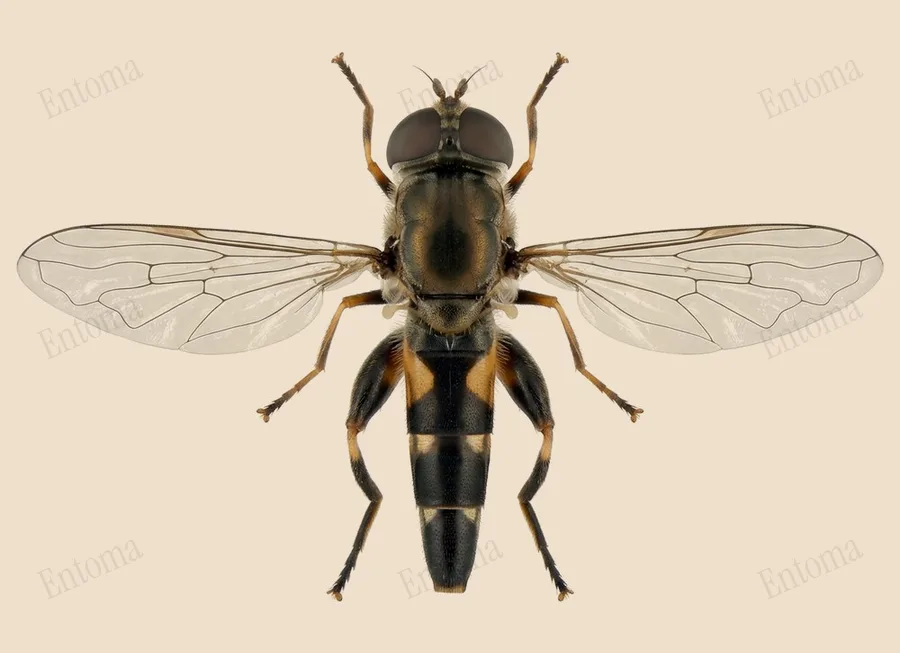
Thick-legged hover fly
Its name comes from the strikingly swollen hind thighs, edged with a row of tiny teeth, a feature most other small hoverflies do not have.
| Where | Gardens, compost heaps, hedgerows |
|---|---|
| Size | 6.5 to 9 mm long |
| When | April to November |
This is a small, slender hoverfly with a distinctly swollen hind femur bearing a row of fine teeth near the tip, and a pair of small white wedge-shaped marks on the thorax just behind the head.
Its larvae develop in wet, rotting organic matter such as compost, manure and silage, feeding on the decaying material, while adults are frequent visitors to garden and hedgerow flowers through summer.
Traits
Habitat
Garden
Colour
Black, Yellow, Grey
Active
Day
To people
Harmless
Activity through the year
Often confused with
Tropidia scita has a large triangular projection near the tip of its hind femur and yellow-orange abdomen segments with a black stripe, unlike the thick-legged hover fly's toothed but unprojected femur and pale-spotted abdomen.
Questions
Is the Thick-legged hover fly dangerous to people?
The Thick-legged hover fly is harmless to people.
When can you see the Thick-legged hover fly?
The Thick-legged hover fly can be seen from April to November, by day.
Plate retouched from a photo by Rego et al. (2022), CC BY 4.0, Wikimedia Commons Licence
Report a mistake in this entry
Last updated 2026-09-26. Every entry is checked against published sources.