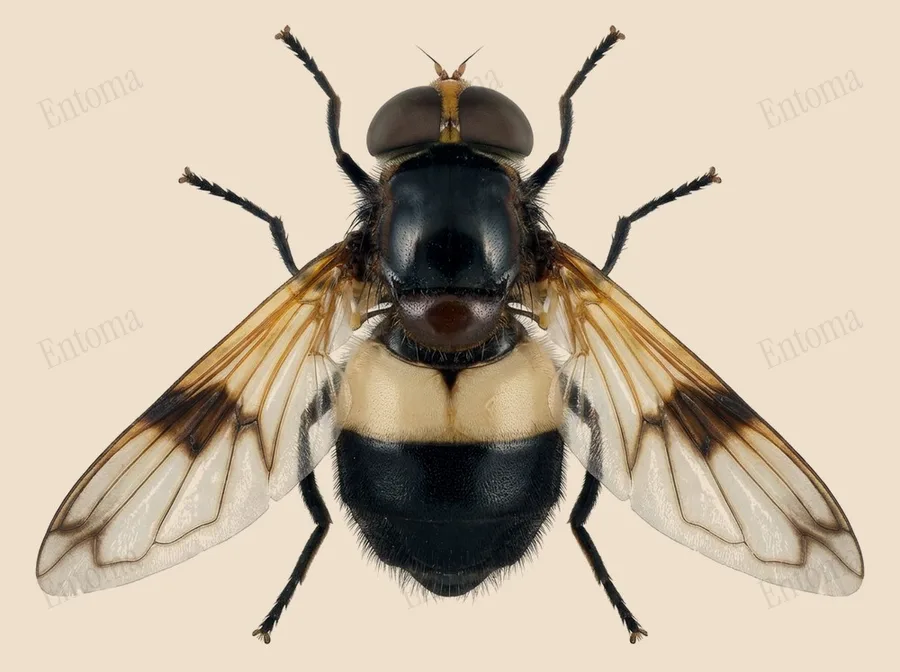
Pellucid hover fly
Its translucent, waist-like abdomen segment gives it its name, and its larvae grow up as scavengers hidden inside the nests of social wasps.
| Where | Woodland edges, hedgerows, gardens |
|---|---|
| Size | 13 to 17 mm long |
| When | May to October |
This is a large, broad-bodied hoverfly with a mostly black body and one wide yellow-white band crossing the front of the abdomen. Its wings carry an amber tint along the leading edge and a dark smudge, and held up to the light the middle of the body can look faintly see-through.
Female hoverflies slip into the nests of social wasps to lay their eggs, and the larvae live at the bottom of the nest, scavenging on dead grubs, food scraps and other debris rather than harming the wasps directly. Adults feed only on nectar and pollen, showing a strong liking for white flowers such as bramble and elder.
Traits
Habitat
Garden
Colour
Black, Yellow
Active
Day
To people
Harmless; adults feed only on nectar and pollen
Activity through the year
Often confused with
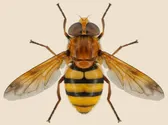
The lesser hornet hoverfly is a similar size but has three yellow bands across an otherwise black abdomen, rather than the pellucid hover fly's single broad band.
Questions
Is the Pellucid hover fly dangerous to people?
Harmless; adults feed only on nectar and pollen.
When can you see the Pellucid hover fly?
The Pellucid hover fly can be seen from May to October, by day.
Plate retouched from a photo by Richard Bartz, Munich aka Makro Freak, CC BY‑SA 2.5, Wikimedia Commons Licence
The plate on this page is shared under the same licence as its source, CC BY-SA.
Report a mistake in this entry
Last updated 2026-09-26. Every entry is checked against published sources.