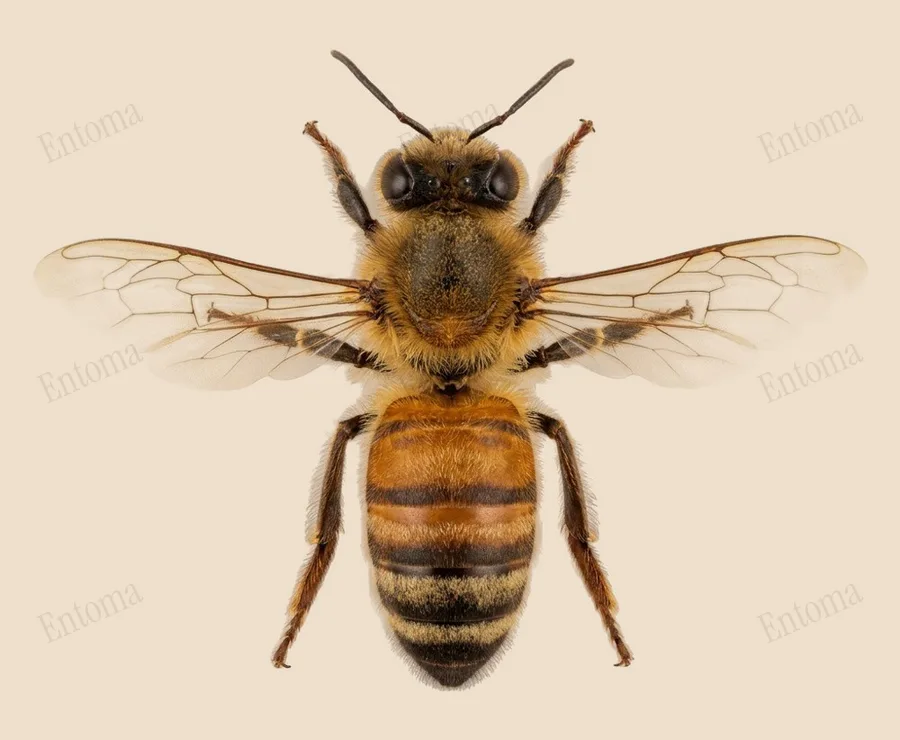
Western honey bee
A worker makes about a twelfth of a teaspoon of honey in its whole life.
| Where | Flowers near hives, gardens, orchards, meadows |
|---|---|
| Size | about 12 mm (worker) |
| When | March to September |
A summer colony holds tens of thousands of workers, up to about 50,000, all daughters of one queen. Summer workers live only a few weeks and wear themselves out foraging.
Returning foragers dance on the comb to share where food is. The angle of the waggle run points to the flower patch relative to the sun.
Fertilised eggs develop into females and unfertilised eggs into males. Workers are females that do not normally reproduce, and the queen is the only fertile female. Native to Europe, the Middle East and Africa, the species has been carried by people to every continent except Antarctica.
Traits
Habitat
Garden
Colour
Yellow, Brown
Active
Day
To people
Take care
Stings if handled or trapped
Activity through the year
Often confused with
The drone fly has one pair of wings, huge eyes and short stubby antennae.
The carder bee is rounder and covered in dense ginger hair.
Read more in the guides
Hornet, wasp or honeybee: how to tell them apartQuestions
Is the Western honey bee dangerous to people?
Take care. Stings if handled or trapped.
When can you see the Western honey bee?
The Western honey bee can be seen from March to September, by day.
Sources en.wikipedia.orgwildlifetrusts.orgedis.ifas.ufl.edu
Plate retouched from a museum specimen photo by University of California Santa Barbara Invertebrate Zoology Collection, Cheadle Center for Biodiversity and Ecological Restoration, CC0, GBIF Licence
Report a mistake in this entry
Bees, wasps and ants›Bees and bumblebees›Apis
Last updated 2026-10-17. Every entry is checked against published sources.