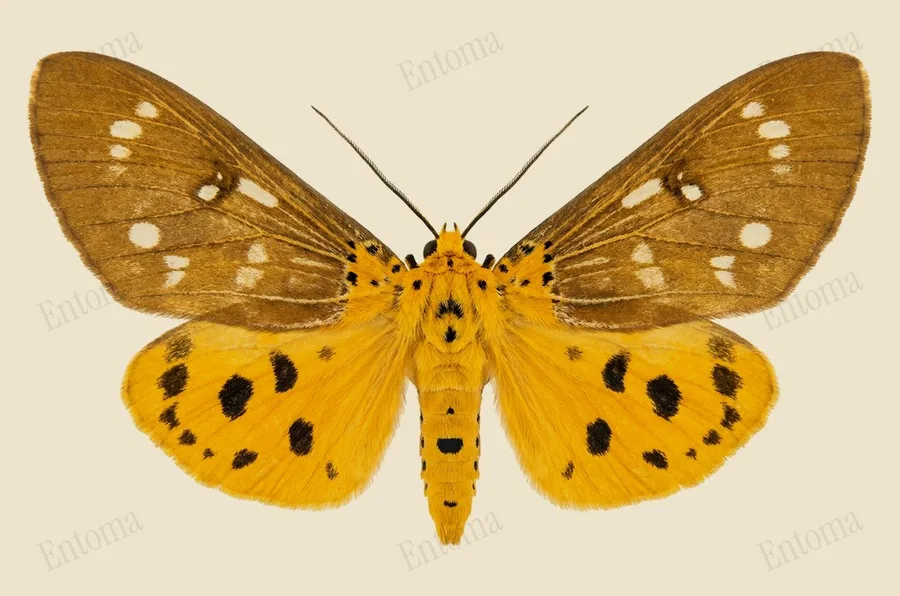
Tropical tiger moth
Its caterpillars feed on fig trees and at least four other unrelated plant families, from teak to paper mulberry, across a range spanning India to Queensland.
| Where | Lowland forest and farmland edges |
|---|---|
| Size | 51 to 58 mm wingspan |
| When | January to December |
The Tropical tiger moth has buff brown forewings and orange yellow hindwings marked with black spots near the cell and margin. Its larva is black above with two white dorsal bands and scattered fine hairs.
It lives in lowland forest and farmland edges, where caterpillars feed on fig, teak, paper mulberry and several other unrelated trees across a wide range from South Asia to Melanesia and Queensland.
Traits
Habitat
Woodland
Colour
Brown, Orange, Black
Active
Night
To people
Not known to sting or bite; caterpillars feed openly on leaves without harming people.
Activity through the year
Often confused with
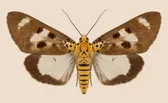
Heliconia tiger moth has darker buff forewings with more irregular white discal spots and much larger black spots along the hindwing margin than the Tropical tiger moth.
Questions
Is the Tropical tiger moth dangerous to people?
Not known to sting or bite; caterpillars feed openly on leaves without harming people.
When can you see the Tropical tiger moth?
The Tropical tiger moth can be seen from January to December, at night.
Plate retouched from a museum specimen photo by Taiwan Biodiversity Research Institute, CC BY 4.0, GBIF Licence
Report a mistake in this entry
Butterflies and moths›Erebid moths›Asota
Last updated 2026-09-27. Every entry is checked against published sources.