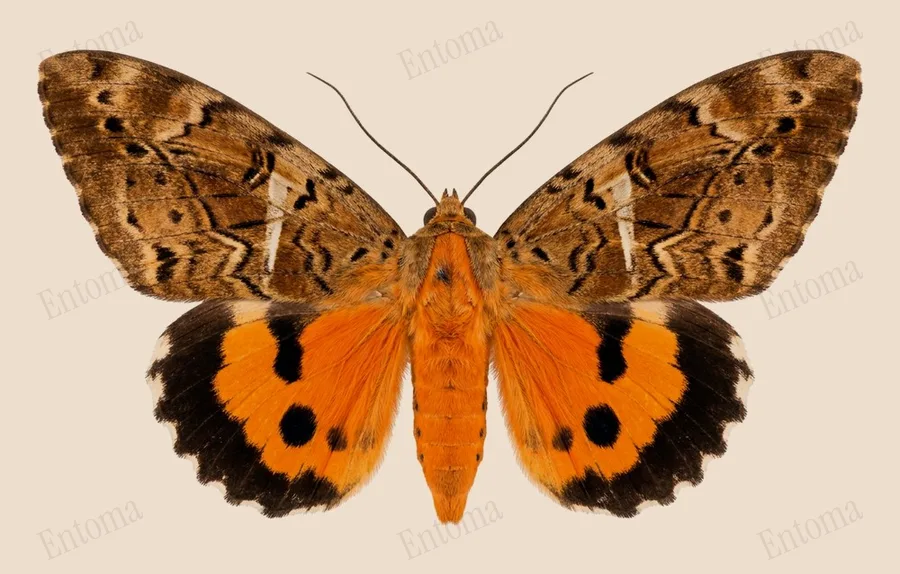
Dot-underwing moth
This moth pierces the skin of ripening fruit at night with a stout, barbed proboscis, feeding on the juice while leaving the fruit to rot from the wound.
| Where | Tropical forest and orchard edges |
|---|---|
| Size | 60 to 96 mm wingspan |
| When | June to January |
The Dot-underwing moth has a greenish grey head, thorax and forewings finely lined with reddish streaks, an orange abdomen, and a single small black dot at the center of each hindwing; females are more strongly marked with rufous forewings.
Adults feed at night on ripening fruit, while caterpillars develop on Tinospora and other Menispermaceae vines in forest from South and Southeast Asia to New Guinea and Australia.
Traits
Habitat
Woodland
Colour
Green, Orange, Grey
Active
Night
To people
Does not sting or bite; adults visit ripening fruit at night rather than people.
Activity through the year
Often confused with
Fruit-piercing moth has a large black crescent mark beyond the end of the cell on each hindwing, while the Dot-underwing moth shows only a small central black dot in the same position.
Questions
Is the Dot-underwing moth dangerous to people?
Does not sting or bite; adults visit ripening fruit at night rather than people.
When can you see the Dot-underwing moth?
The Dot-underwing moth can be seen from June to January, at night.
Plate retouched from a museum specimen photo by San Diego Natural History Museum, CC0, GBIF Licence
Report a mistake in this entry
Butterflies and moths›Erebid moths›Eudocima
Last updated 2026-09-27. Every entry is checked against published sources.