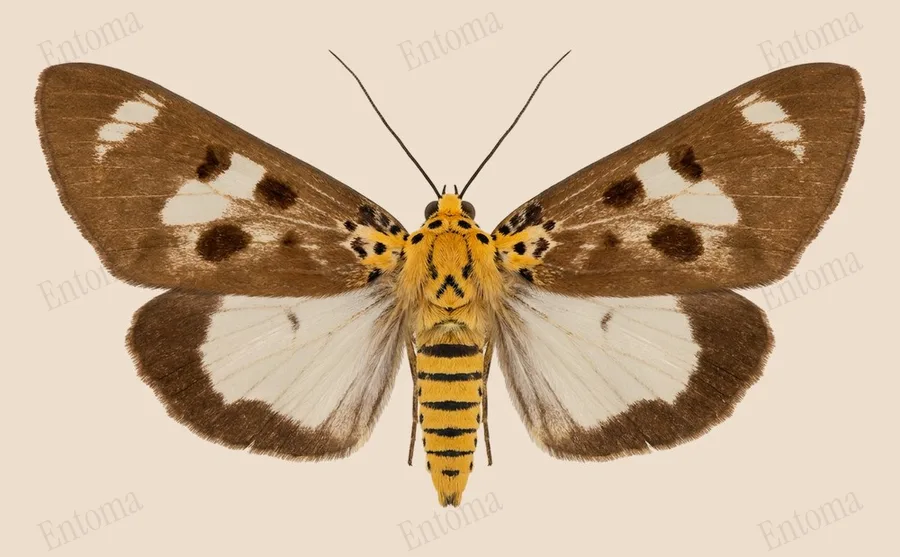
Snouted tiger moth
Its caterpillars feed on starfruit and related Averrhoa trees, and adults vary so much in wing pattern across the Indo-Australian tropics that 26 regional subspecies have been described.
| Where | Tropical forests of Asia and Australasia |
|---|---|
| Size | 40 to 52 mm wingspan |
| When | January to December |
Adults have dark grey forewings crossed by a narrow white wedge and pale hindwings broadly bordered in dark grey, with a wingspan of roughly 40 to 52 millimeters. The head and collar are marked with black spots on an orange background.
Caterpillars feed on the leaves of starfruit and related Averrhoa trees, and the adult moth's wing pattern varies so much across its range, from South and Southeast Asia to Queensland and the Solomon Islands, that dozens of local subspecies have been named.
Traits
Habitat
Woodland
Colour
Grey, White, Orange
Active
Night
To people
Not known to sting or bite; safe to handle gently if needed.
Activity through the year
Often confused with
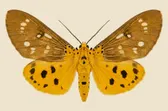
Hindwings orange yellow with black spots and brownish forewings, unlike the pale, dark grey bordered hindwings and dark grey forewings of the Snouted tiger moth.
Questions
Is the Snouted tiger moth dangerous to people?
Not known to sting or bite; safe to handle gently if needed.
When can you see the Snouted tiger moth?
The Snouted tiger moth can be seen from January to December, at night.
Plate retouched from a museum specimen photo by Taiwan Biodiversity Research Institute, CC BY 4.0, GBIF Licence
Report a mistake in this entry
Butterflies and moths›Erebid moths›Asota
Last updated 2026-09-27. Every entry is checked against published sources.