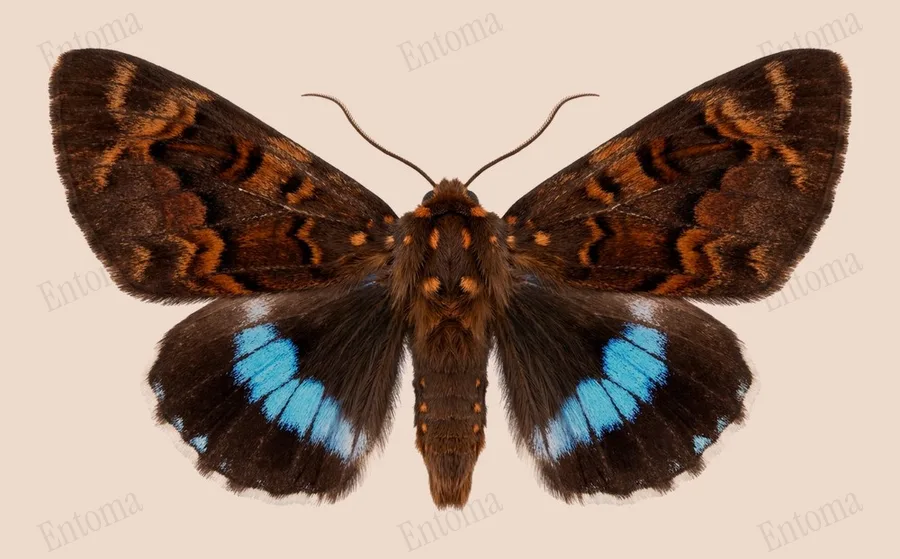
Ramie moth
This moth's dark brown forewings are speckled with silvery blue scales, and its hindwings carry a bright blue patch that stays hidden until it takes flight.
| Where | Nettle family shrubland and forest edges |
|---|---|
| Size | 65 to 90 mm wingspan |
| When | January to December |
Adults are large, dark brown moths with black markings and a scattering of silvery blue scales on the forewings, scalloped wing edges, and hindwings marked with bright silvery blue patches that are hidden when the wings are folded at rest.
Caterpillars feed on ramie and other plants in the nettle family, and when disturbed they rear up the head, thrash from side to side and bring up a green fluid to deter predators. In warm parts of its range, adults can be found flying throughout the year.
Traits
Habitat
Woodland
Colour
Brown, Blue
Active
Night
To people
Adults do not sting or bite and are harmless to people; only the caterpillar's defensive display and fluid are meant for predators, not for humans.
Activity through the year
Often confused with
Has an orange hindwing with only a small, reduced black patch, unlike the black hindwing with a bright blue patch carried by the Ramie moth.
Questions
Is the Ramie moth dangerous to people?
Adults do not sting or bite and are harmless to people; only the caterpillar's defensive display and fluid are meant for predators, not for humans.
When can you see the Ramie moth?
The Ramie moth can be seen from January to December, at night.
Plate retouched from a museum specimen photo by Taiwan Biodiversity Research Institute, CC BY 4.0, GBIF Licence
Report a mistake in this entry
Butterflies and moths›Erebid moths›Arcte
Last updated 2026-09-27. Every entry is checked against published sources.