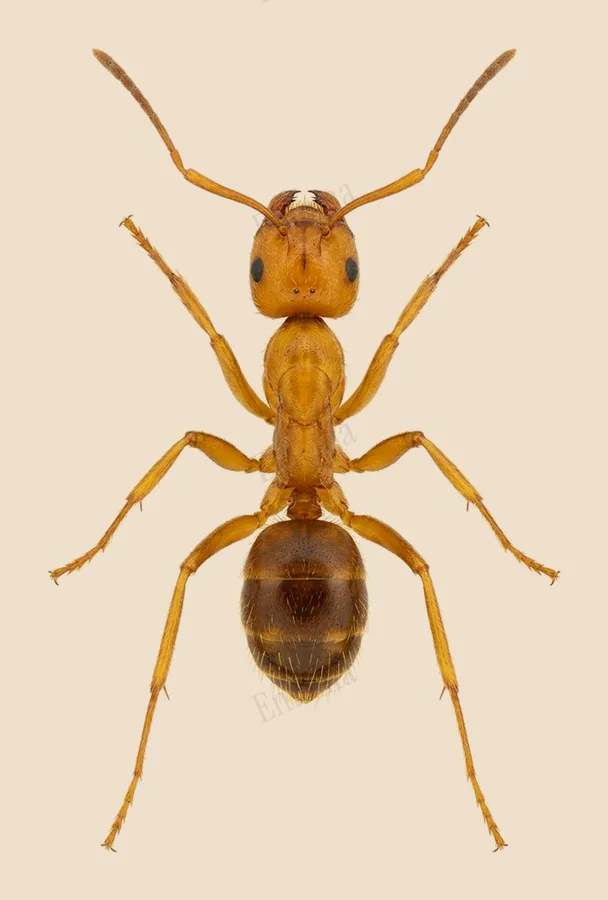
Yellow crazy ant
Instead of a sting, this ant defends itself and subdues prey by spraying formic acid from pores at the tip of its abdomen.
| Where | Gardens, farmland and forest edges |
|---|---|
| Size | 4 to 6 mm body length |
| When | January to December |
The Yellow crazy ant is a slender, yellowish brown ant with a darker abdomen, unusually long legs and antennae, and workers that are all roughly the same size within a colony.
Unable to sting, it nips with its jaws and sprays formic acid into the wound to subdue prey or defend itself, and it nests under leaf litter, in tree hollows and in disturbed ground across forests, gardens and farmland.
Traits
Habitat
Garden
Colour
Yellow, Brown
Active
Day and night
To people
Mild
Bites and can spray irritating formic acid in defence when handled or disturbed; safe to observe from a distance.
Activity through the year
Often confused with
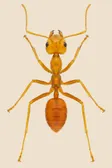
Considerably larger, with major workers 8 to 10 mm long, and far more aggressive, delivering a painful bite backed by a formic acid spray, unlike the smaller, less aggressive Yellow crazy ant.
Questions
Is the Yellow crazy ant dangerous to people?
Mild. Bites and can spray irritating formic acid in defence when handled or disturbed; safe to observe from a distance.
When can you see the Yellow crazy ant?
The Yellow crazy ant can be seen from January to December, by day and at night.
Plate retouched from a museum specimen photo by Christian Cabuslay, California Academy of Sciences, CC BY 4.0, GBIF Licence
Report a mistake in this entry
Bees, wasps and ants›Ants›Anoplolepis
Last updated 2026-09-27. Every entry is checked against published sources.