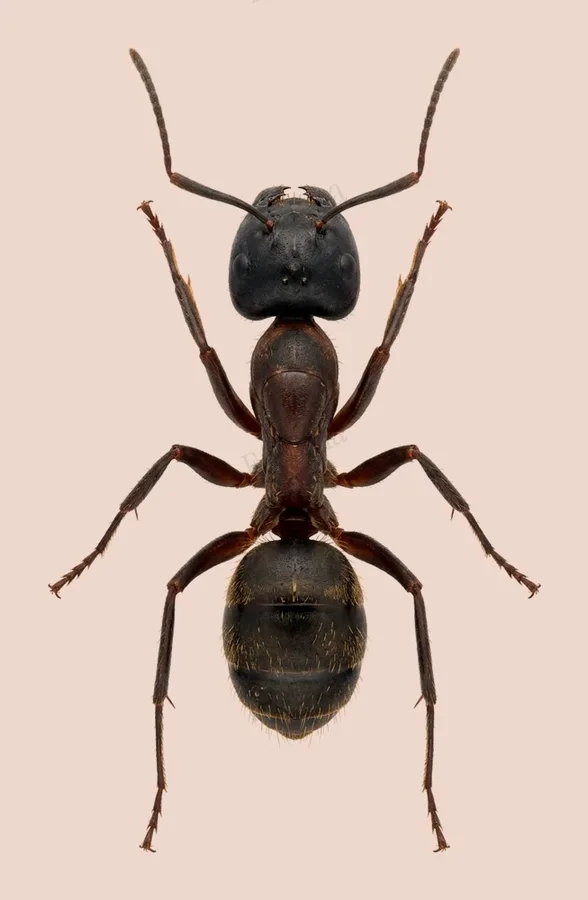
Indian black ant
Indian black ant workers vary greatly in size within a single colony, and foragers guide nestmates to food by leading them there directly rather than laying scent trails.
| Where | Gardens, farmland and tree hollows |
|---|---|
| Size | 5 to 18 mm body length |
| When | January to December |
The Indian black ant is a large, polymorphic carpenter ant with jet black, shining workers ranging from small minors to much bigger, heavy-headed majors, all with reddish brown legs and antennae; queens grow larger still, and colonies can hold several thousand workers nesting in dead wood, soil or tree hollows.
Workers forage mainly at night, tending sap-sucking insects such as aphids for honeydew and defending them from predators in return, and some foragers guide nestmates to newly found food by leading them there directly rather than relying on scent trails; the ants bite rather than sting, spraying formic acid into the wound if seized.
Traits
Habitat
Garden
Colour
Black, Brown
Active
Night
To people
Mild
Females and workers can bite; the bite is usually mild and the species is not considered aggressive.
Activity through the year
Often confused with
Gaster covered in dense golden pubescence giving a shimmering sheen, unlike the dull, matte black body of the Indian black ant.
Questions
Is the Indian black ant dangerous to people?
Mild. Females and workers can bite; the bite is usually mild and the species is not considered aggressive.
When can you see the Indian black ant?
The Indian black ant can be seen from January to December, at night.
Plate retouched from a museum specimen photo by Ryan Perry, California Academy of Sciences, CC BY 4.0, GBIF Licence
Report a mistake in this entry
Bees, wasps and ants›Ants›Camponotus
Last updated 2026-09-27. Every entry is checked against published sources.