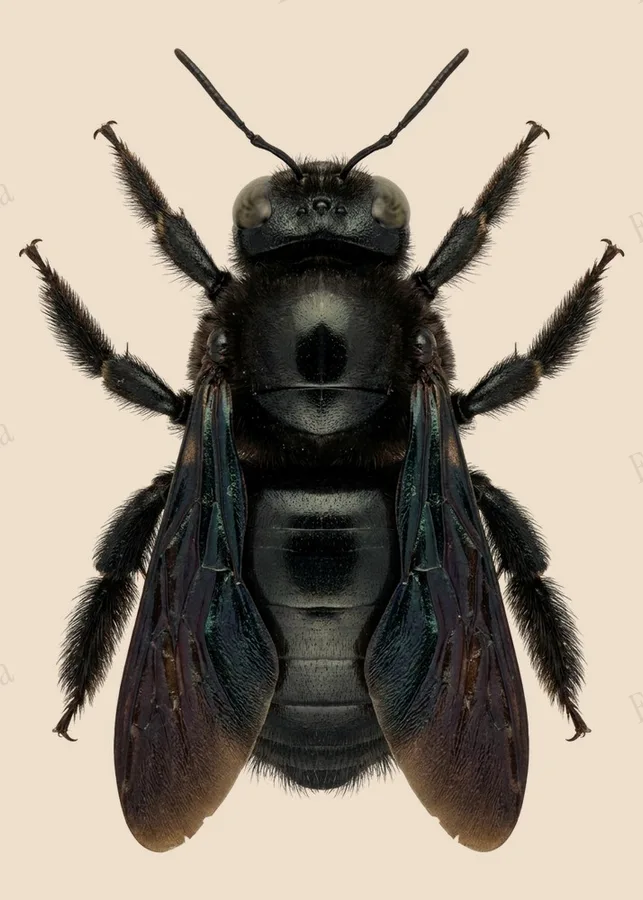
Broad-handed carpenter bee
Despite being among the largest bees on Earth, this species has a mild sting that people who have been stung describe as far less painful than expected.
| Where | Forests, dead wood and gardens |
|---|---|
| Size | 30 to 35 mm body length |
| When | January to December |
This is a very large, robust bee that is shiny black all over, with wings that flash metallic blue green or purple in sunlight. It is among the largest carpenter bees and among the largest bees anywhere.
Females burrow long tunnels into dead wood such as fallen trees and wooden structures to build their nests, and the species can produce more than one generation a year wherever flowers are available year round.
Traits
Habitat
Woodland
Colour
Black, Metallic
Active
Day
To people
Mild
Females can sting but the species is not aggressive and rarely stings unless handled; males cannot sting at all.
Activity through the year
Often confused with
Xylocopa aestuans is much smaller, around 18 mm, with a band of bright yellow hairs across the top of the thorax, unlike the uniformly shiny black Broad-handed carpenter bee.
Questions
Is the Broad-handed carpenter bee dangerous to people?
Mild. Females can sting but the species is not aggressive and rarely stings unless handled; males cannot sting at all.
When can you see the Broad-handed carpenter bee?
The Broad-handed carpenter bee can be seen from January to December, by day.
Plate retouched from a photo by John Witton, CC BY 4.0, iNaturalist Licence
Report a mistake in this entry
Bees, wasps and ants›Bees and bumblebees›Xylocopa
Last updated 2026-09-27. Every entry is checked against published sources.