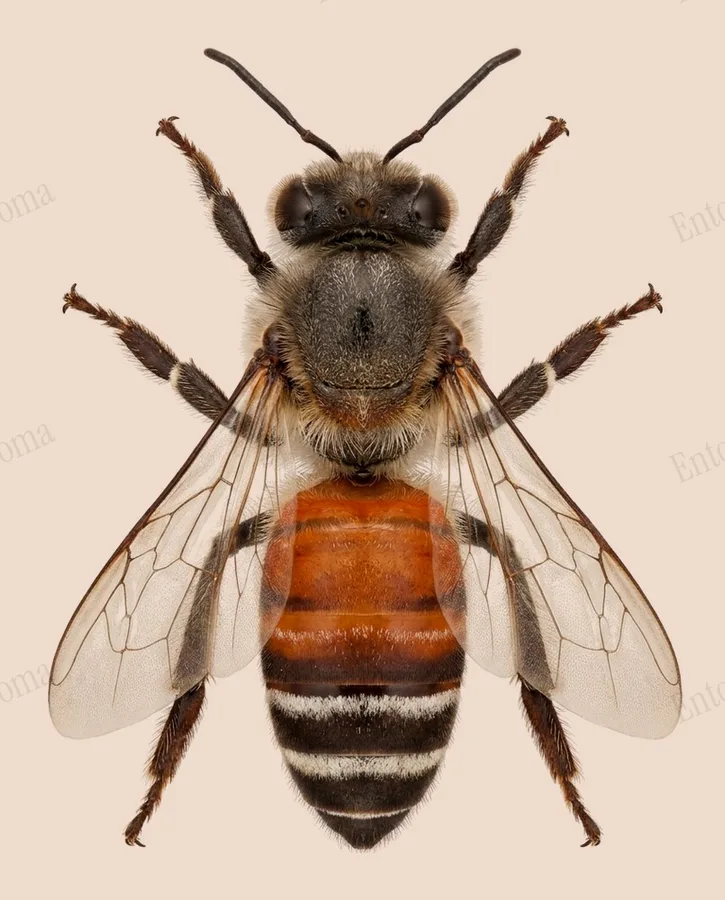
Red dwarf honey bee
This bee builds just one exposed sheet of honeycomb on a tree branch or shrub, rather than the enclosed, multi comb nests built by other honey bees.
| Where | Woodland, scrub and disturbed ground |
|---|---|
| Size | 7 to 10 mm body length |
| When | January to December |
The Red dwarf honey bee is among the smallest honey bees, with reddish brown workers and a slender build compared with larger honey bee species. Its single comb, wrapped by a curtain of clustered bees, usually hangs from a branch or shrub in a shaded spot.
Colonies defend their exposed nest actively, and can respond to a disturbance with a coordinated hissing signal that spreads through the bee curtain within a second. Workers forage on a wide range of flowers across forests, farmland and gardens throughout South and Southeast Asia.
Traits
Habitat
Woodland
Colour
Brown, Red, Black
Active
Day
To people
Take care
Female workers can sting; colonies are usually calm away from the nest but mount a coordinated defence if the single exposed comb is disturbed.
Activity through the year
Often confused with
The Black dwarf honey bee has black first two abdominal segments and a black scutellum, compared with the reddish brown abdomen and scutellum of the Red dwarf honey bee.
Questions
Is the Red dwarf honey bee dangerous to people?
Take care. Female workers can sting; colonies are usually calm away from the nest but mount a coordinated defence if the single exposed comb is disturbed.
When can you see the Red dwarf honey bee?
The Red dwarf honey bee can be seen from January to December, by day.
Plate retouched from a museum specimen photo by Harry Taylor NHM photo unit, Natural History Museum, CC0, GBIF Licence
Report a mistake in this entry
Bees, wasps and ants›Bees and bumblebees›Apis
Last updated 2026-09-27. Every entry is checked against published sources.