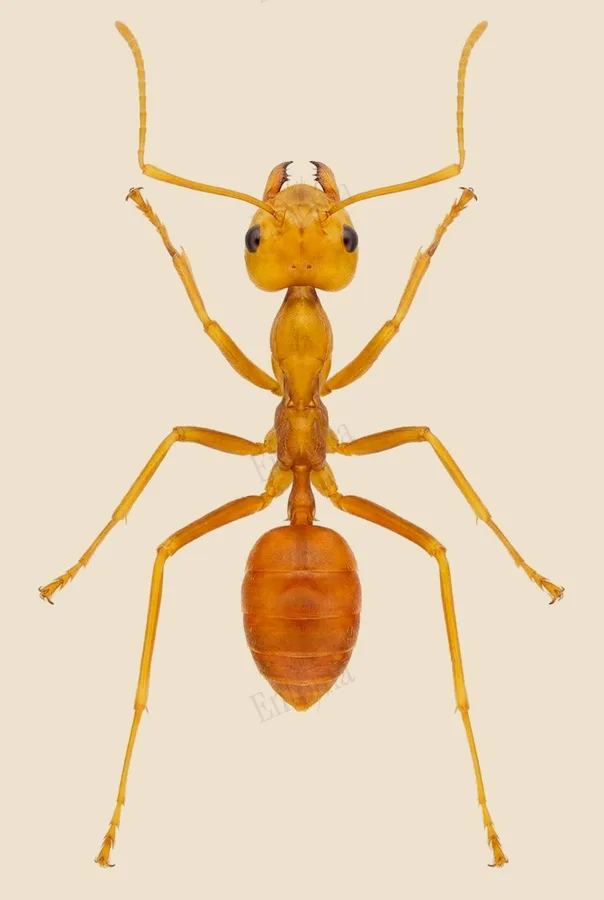
Asian weaver ant
A single Asian weaver ant colony can occupy dozens of trees at once, its workers stitching leaves into nests using silk borrowed from their own larvae.
| Where | Tree canopies in forest and orchards |
|---|---|
| Size | 5 to 10 mm body length |
| When | January to December |
The Asian weaver ant is a slender, long legged ant with an orange red body, workers coming in two clear sizes: smaller minors that tend the brood and larger majors with strong mandibles that forage and build. Colonies can hold half a million ants spread across many interconnected leaf nests in the same or neighbouring trees.
Major workers pull leaves together while minor workers hold larvae along the seam, letting the larvae spin silk that glues the leaf edges shut, and a large nest can be finished within a single night. The ants have no sting but bite hard and spray formic acid into the wound, defending their canopy nests aggressively.
Traits
Habitat
Woodland
Colour
Orange, Brown
Active
Day
To people
Take care
Cannot sting but bites hard and sprays irritating formic acid into the wound; colonies defend their leaf nests aggressively if disturbed.
Activity through the year
Often confused with
The Tropical fire ant nests in bare soil mounds rather than stitched leaf nests in trees, is smaller at 2 to 6 mm, and has a functional sting, unlike the stingless, tree nesting Asian weaver ant.
Questions
Is the Asian weaver ant dangerous to people?
Take care. Cannot sting but bites hard and sprays irritating formic acid into the wound; colonies defend their leaf nests aggressively if disturbed.
When can you see the Asian weaver ant?
The Asian weaver ant can be seen from January to December, by day.
Plate retouched from a museum specimen photo by April Nobile, California Academy of Sciences, CC BY 4.0, GBIF Licence
Report a mistake in this entry
Bees, wasps and ants›Ants›Oecophylla
Last updated 2026-09-27. Every entry is checked against published sources.