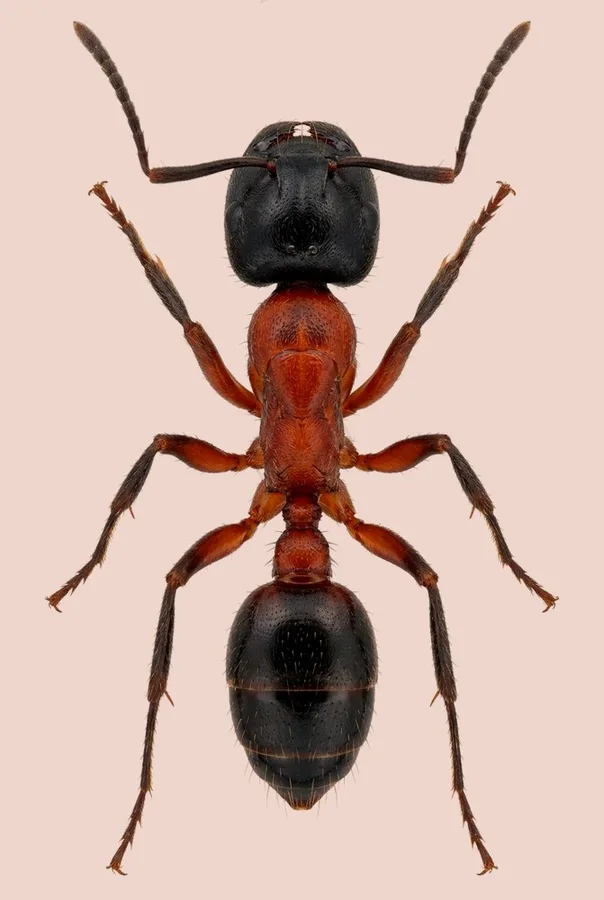
Arboreal bicolored slender ant
This slender ant nests inside dead wood high in the forest canopy, its colonies keeping entrances so narrow that only one worker can pass at a time.
| Where | Tree trunks in tropical forest |
|---|---|
| Size | 10 to 12 mm body length |
| When | January to December |
The Arboreal bicolored slender ant has a black head and abdomen contrasting sharply with an orange-red thorax, and a slender body about 10 to 12 mm long, carried on short legs.
Colonies of a few hundred workers nest inside dead branches and stumps in tropical forest, and workers defend the nest aggressively, stinging intruders that come too close.
Traits
Habitat
Woodland
Colour
Black, Orange
Active
Day
To people
Take care
Worker ants, which are all female, can sting when disturbed; the sting is painful and causes brief local swelling, and rarely a stronger allergic reaction in sensitive people.
Activity through the year
Often confused with
Black slender ant is uniformly black, without the sharply two-toned black-and-orange-red pattern of the Arboreal bicolored slender ant.
Questions
Is the Arboreal bicolored slender ant dangerous to people?
Take care. Worker ants, which are all female, can sting when disturbed; the sting is painful and causes brief local swelling, and rarely a stronger allergic reaction in sensitive people.
When can you see the Arboreal bicolored slender ant?
The Arboreal bicolored slender ant can be seen from January to December, by day.
Plate retouched from a museum specimen photo by Michele Esposito, California Academy of Sciences, CC BY 4.0, GBIF Licence
Report a mistake in this entry
Bees, wasps and ants›Ants›Tetraponera
Last updated 2026-09-27. Every entry is checked against published sources.