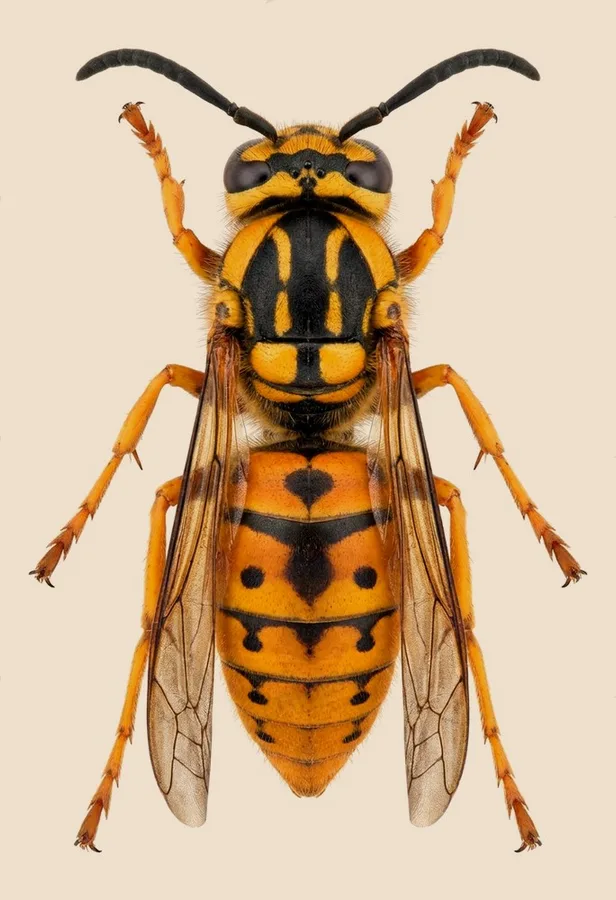
Southern yellowjacket
Colonies of this wasp can grow into some of the largest yellowjacket nests in North America, occasionally holding over 100,000 workers in warm climates.
| Where | Yards, roadsides and disturbed open ground |
|---|---|
| Size | 9 to 20 mm long (body length) |
| When | March to December |
The Southern yellowjacket is a black and yellow social wasp, 9 to 20 mm long, with queens noticeably larger and more orange-tinted than workers. It nests mainly underground, though nests are sometimes found above ground, in walls, or in thick shrubbery.
In warm climates a nest can survive more than one year, growing into one of the largest yellowjacket colonies in North America, with some reported to hold over 100,000 workers. Colonies defend themselves fiercely, releasing alarm pheromones that bring workers swarming to sting an intruder repeatedly.
Traits
Habitat
Towns
Colour
Black, Yellow, Orange
Active
Day
To people
Take care
Only females can sting, and colonies defend their nests aggressively with repeated, painful stings.
Activity through the year
Often confused with
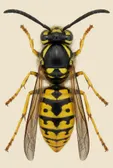
Shows a wide, anchor-shaped black mark at the front of the abdomen and lacks the lengthwise black and yellow stripes on the plate behind the head that mark the Southern yellowjacket.
Questions
Is the Southern yellowjacket dangerous to people?
Take care. Only females can sting, and colonies defend their nests aggressively with repeated, painful stings.
When can you see the Southern yellowjacket?
The Southern yellowjacket can be seen from March to December, by day.
Plate retouched from a museum specimen photo by Hillery Warner, Natural History Museum, CC0, GBIF Licence
Report a mistake in this entry
Bees, wasps and ants›Wasps and hornets›Vespula
Last updated 2026-09-27. Every entry is checked against published sources.