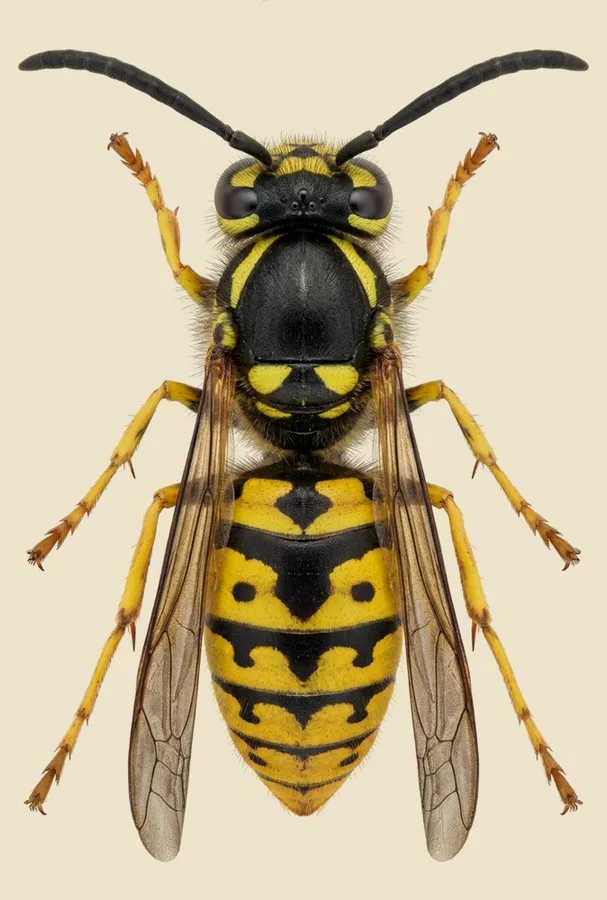
Eastern yellowjacket
A colony founded by a single queen each spring can hold several thousand workers in an underground paper nest by late summer.
| Where | Lawns, parks and woodland edges |
|---|---|
| Size | 12 to 18 mm body length |
| When | April to November |
The Eastern yellowjacket is black and yellow with an anchor shaped black mark on the first abdominal segment and black bands that are flat on top and wavy along the bottom edge on the following segments.
Nests are built underground, usually hidden in old rodent burrows or wall cavities, and workers defend them aggressively, stinging repeatedly when the colony is disturbed, especially through late summer and fall across lawns, parks, and woodland edges.
Traits
Habitat
Towns
Colour
Black, Yellow
Active
Day
To people
Take care
Stings when its nest is disturbed and can sting more than once; painful for most people.
Activity through the year
Often confused with
Queens are mostly orange with reduced black markings, unlike the Eastern yellowjacket's more evenly black and yellow banded pattern, and it often nests as a social parasite inside Eastern yellowjacket colonies.
Questions
Is the Eastern yellowjacket dangerous to people?
Take care. Stings when its nest is disturbed and can sting more than once; painful for most people.
When can you see the Eastern yellowjacket?
The Eastern yellowjacket can be seen from April to November, by day.
Plate retouched from a photo by tzfitch, CC0, iNaturalist Licence
Report a mistake in this entry
Bees, wasps and ants›Wasps and hornets›Vespula
Last updated 2026-09-26. Every entry is checked against published sources.