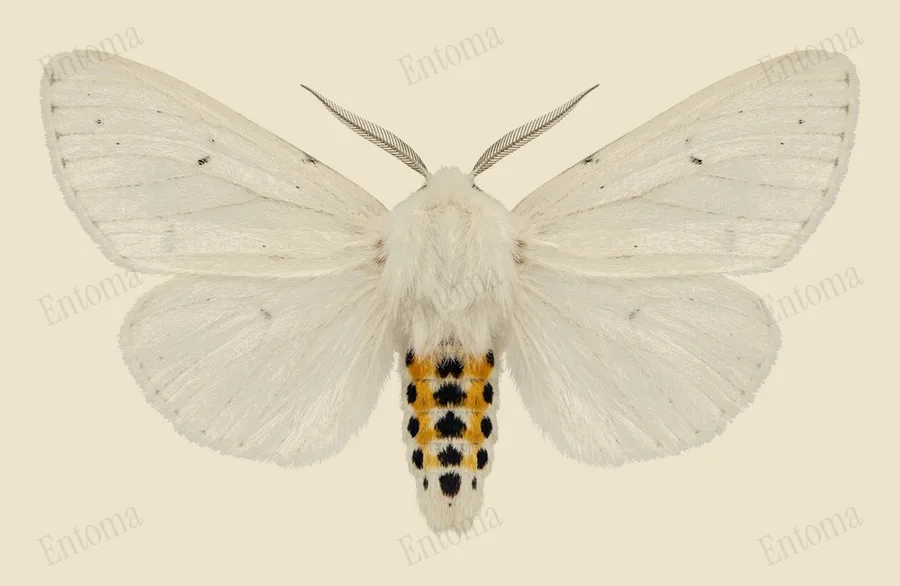
Virginian tiger moth
Its caterpillar, called the yellow woolly bear, is covered in dense hairs that give it the look of a pipe cleaner rather than wool, despite the name.
| Where | Fields, gardens and woodland edges |
|---|---|
| Size | 30 to 51 mm wingspan |
| When | April to October |
The Virginian tiger moth is a white moth usually marked with only a few small black spots on the wings, and males show yellowish orange hindwings while females have white ones. Its caterpillar, the yellow woolly bear, is covered in dense hairs ranging from pale yellow to rusty orange.
Caterpillars feed on a wide range of plants including dandelion, clover and various trees and shrubs, and are most often seen from late summer into fall. Their hairs are not venomous but can irritate sensitive skin, similar to fiberglass, if handled.
Traits
Habitat
Garden
Colour
White, Yellow
Active
Night
To people
Mild
Not venomous, but the caterpillar's hairs can irritate sensitive skin if handled.
Activity through the year
Often confused with
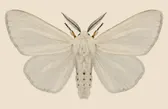
Has forewing spots that are rectangular or wedge shaped and arranged in loose rows, rather than the rounder spots arranged in bands seen on the Virginian tiger moth.
Questions
Is the Virginian tiger moth dangerous to people?
Mild. Not venomous, but the caterpillar's hairs can irritate sensitive skin if handled.
When can you see the Virginian tiger moth?
The Virginian tiger moth can be seen from April to October, at night.
Plate retouched from a museum specimen photo by AJ Thomas, Colorado State University, C.P. Gillette Museum of Arthropod Diversity, CC0, GBIF Licence
Report a mistake in this entry
Butterflies and moths›Erebid moths›Spilosoma
Last updated 2026-09-26. Every entry is checked against published sources.