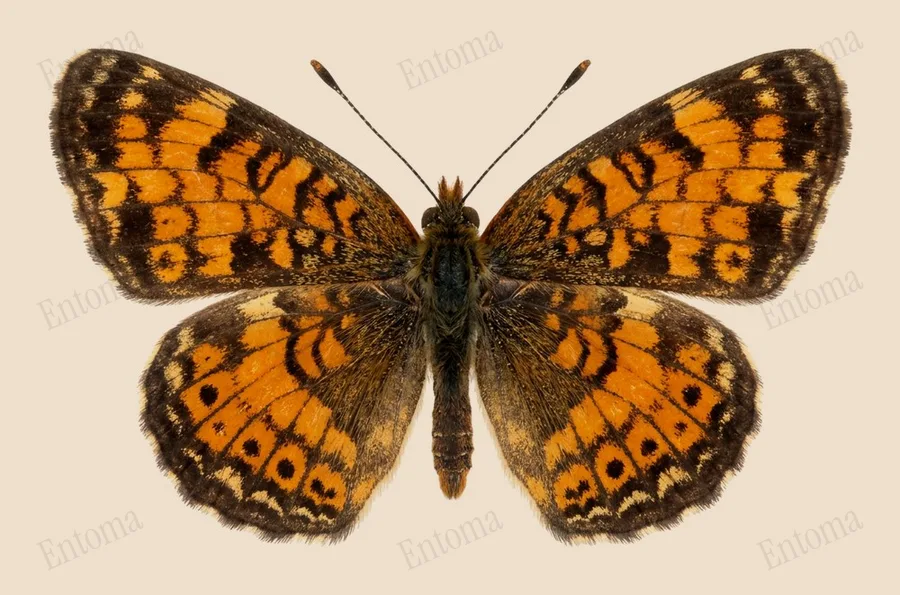
Pearl crescent
Females glue their eggs in stacked clusters up to three layers deep on a single aster leaf.
| Where | Open fields, meadows, and roadsides |
|---|---|
| Size | 25 to 40 mm wingspan |
| When | April to October |
The Pearl crescent is a small orange and black butterfly with fine dark markings above, and from below shows a pale, pearly crescent mark ringed in dark brown near the outer edge of the hindwing.
Caterpillars feed on smooth-leaved asters, and a partly grown caterpillar from the last brood of the year overwinters under fallen leaves before finishing its growth the following spring, with two to four broods produced across a year.
Traits
Habitat
Grassland
Colour
Orange, Black
Active
Day
To people
Does not sting or bite; males perch low and chase off other butterflies that enter their territory.
Activity through the year
Often confused with
Very similar in size and color, but the Northern crescent has orange antenna tips and a mostly solid black hindwing margin above, while the Pearl crescent has black and white antenna tips and a line of pale crescents along the hindwing margin.
Questions
Is the Pearl crescent dangerous to people?
Does not sting or bite; males perch low and chase off other butterflies that enter their territory.
When can you see the Pearl crescent?
The Pearl crescent can be seen from April to October, by day.
Plate retouched from a photo by Catherine C. Galley, CC BY 4.0, iNaturalist Licence
Report a mistake in this entry
Butterflies and moths›Brush-footed butterflies›Phyciodes
Last updated 2026-09-26. Every entry is checked against published sources.