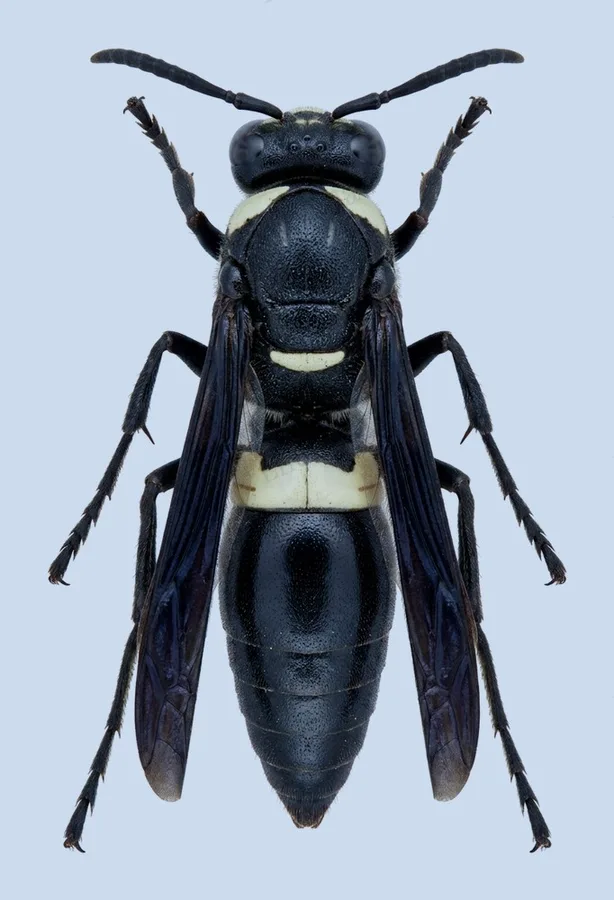
Four-toothed mason wasp
This solitary wasp lays male eggs near the entrance of her mud-walled nest and female eggs further back, so daughters, protected deepest, emerge last.
| Where | Gardens, meadows and woodland edges |
|---|---|
| Size | 15 to 21 mm long (body length) |
| When | April to October |
The Four-toothed mason wasp is a shiny black wasp, 15 to 21 mm long, with white shoulder marks and thin white bands before and after its narrow waist. Its wings have an iridescent blue-purple sheen.
Females nest alone in existing cavities such as old carpenter bee tunnels or hollow stems, building mud partitions between cells and provisioning each with a paralyzed caterpillar. They are docile and much more likely to fly away than to sting, doing so only when seriously threatened.
Traits
Habitat
Garden
Colour
Black, White
Active
Day
To people
Mild
Females can sting if seriously threatened, but they are solitary and usually just fly away.
Activity through the year
Often confused with
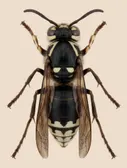
Has extensive white markings across its face, which the Four-toothed mason wasp lacks entirely, and lives socially in large paper nests rather than nesting alone in mud-walled cavities.
Questions
Is the Four-toothed mason wasp dangerous to people?
Mild. Females can sting if seriously threatened, but they are solitary and usually just fly away.
When can you see the Four-toothed mason wasp?
The Four-toothed mason wasp can be seen from April to October, by day.
Plate retouched from a museum specimen photo by Davidson College, CC0, GBIF Licence
Report a mistake in this entry
Bees, wasps and ants›Potter wasps›Monobia
Last updated 2026-09-27. Every entry is checked against published sources.