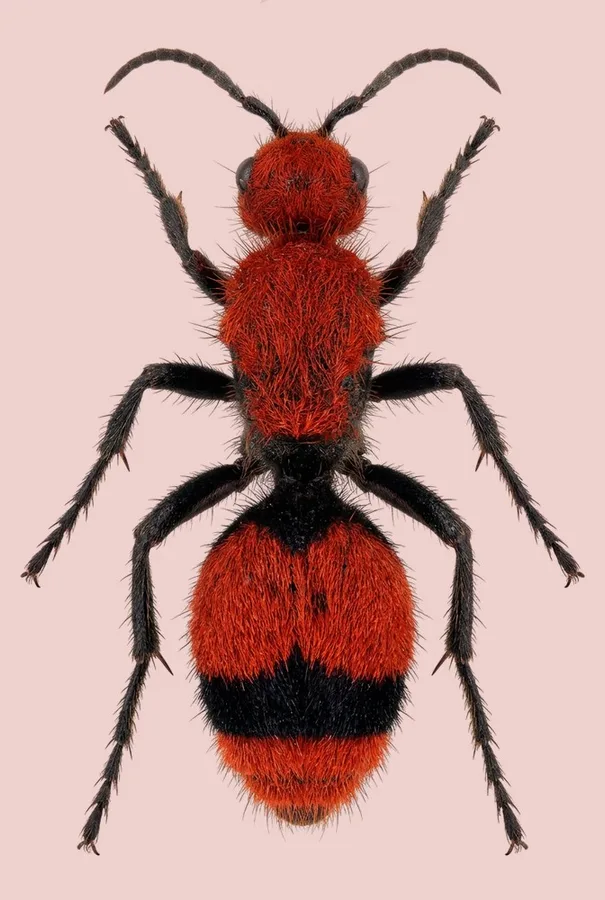
Common eastern velvet ant
Only the wingless female can sting, and though her venom is mild chemically, the pain is so intense people nicknamed her the cow killer.
| Where | Open sunny fields and sandy ground |
|---|---|
| Size | 15 to 25 mm body length |
| When | May to October |
This is a wasp, not an ant: the wingless, densely furred female is black with bright red-orange hair covering her thorax and abdomen, while the smaller winged male is dark and far less conspicuous.
Females spend daylight hours running rapidly across open sandy ground searching for the underground nests of bumble bees, in which their own larvae develop as parasitoids.
Traits
Habitat
Grassland
Colour
Black, Red, Orange
Active
Day
To people
Take care
Females can sting; the sting is very painful but not dangerous to a healthy adult.
Activity through the year
Often confused with
Similar in size and armed with an equally painful sting, the Thistledown Velvet Ant is covered in long white hairs that give it a pale, fuzzy look, rather than the black body with red-orange patches of the Eastern Velvet Ant.
Questions
Is the Common eastern velvet ant dangerous to people?
Take care. Females can sting; the sting is very painful but not dangerous to a healthy adult.
When can you see the Common eastern velvet ant?
The Common eastern velvet ant can be seen from May to October, by day.
Plate retouched from a photo by Judy Gallagher, CC BY‑SA 4.0, iNaturalist Licence
The plate on this page is shared under the same licence as its source, CC BY-SA.
Report a mistake in this entry
Bees, wasps and ants›Velvet ants›Dasymutilla
Last updated 2026-09-27. Every entry is checked against published sources.