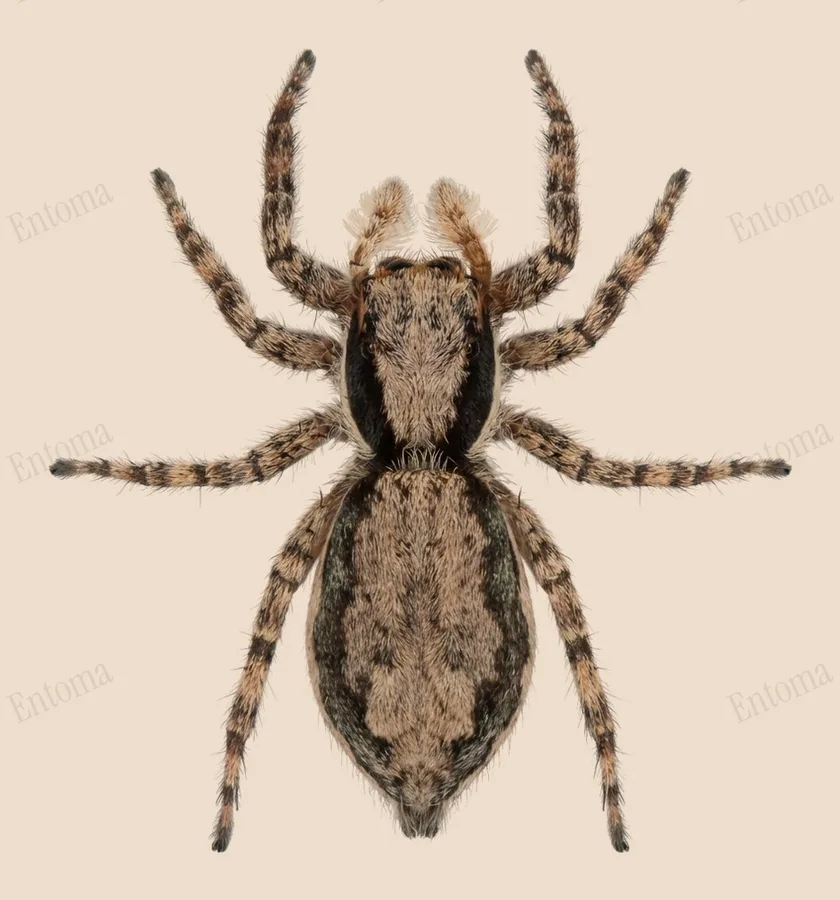
Gray wall jumping spider
This jumping spider lives almost entirely on buildings, gathering near outdoor lights after dark to snap up the insects the lights attract.
| Where | Buildings and walls in warm regions |
|---|---|
| Size | Male 8 to 9 mm, female 8 to 10 mm body length |
| When | February to December |
This flattened jumping spider is covered in short, dense grayish white hairs. Males are boldly striped in black and white along the carapace and abdomen with a white inverted V mark on the face, while females are plainer gray above with broad black stripes down each side of the abdomen; males run 8 to 9 mm and females 8 to 10 mm.
It lives almost exclusively on man made structures such as walls and buildings, catching flies and other insects that gather around outdoor lights at night. The female spins a flat white silken eggsac in a crevice and guards 25 to 40 eggs inside it until they hatch.
Traits
Habitat
Towns
Colour
Grey, Black, White
Active
Night
To people
This spider does not bite people and is not dangerous; it is a useful predator of flies and mosquitoes around buildings.
Activity through the year
Often confused with
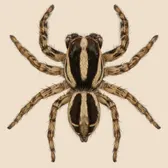
Has a light central stripe bordered by dark stripes on the abdomen, the reverse of the gray wall jumping spider's dark central stripe bordered by light stripes.
Questions
Is the Gray wall jumping spider dangerous to people?
This spider does not bite people and is not dangerous; it is a useful predator of flies and mosquitoes around buildings.
When can you see the Gray wall jumping spider?
The Gray wall jumping spider can be seen from February to December, at night.
Plate retouched from a photo by portioid, CC BY 4.0, iNaturalist Licence
Report a mistake in this entry
Spiders›Jumping spiders›Menemerus
Last updated 2026-09-27. Every entry is checked against published sources.