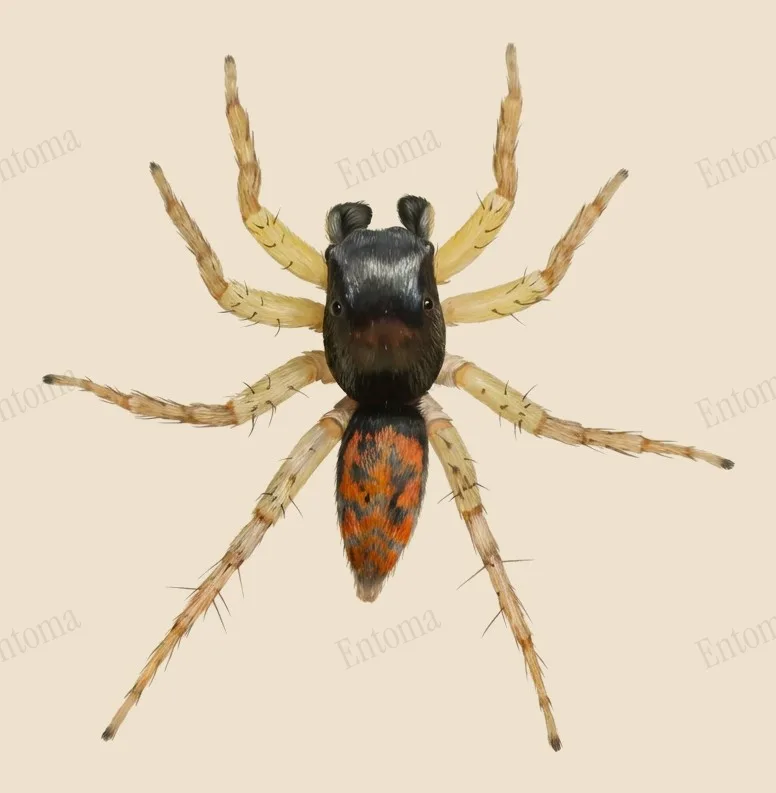
Dimorphic jumping spider
Male dimorphic jumping spiders come in two entirely different forms, a black tufted type and a striped tuftless type, and each courts females in its own distinctive way.
| Where | Vines, shrubs and tree trunks |
|---|---|
| Size | Female 6.5 to 10 mm, male 4.75 to 7 mm body length |
| When | March to October |
The dimorphic jumping spider is unusual because males occur in two distinct forms. The tufted male is black with three small tufts of hair across the front of its head and pale legs, while the striped male is black and white with bright orange palps and no tufts. Females are mottled brown with a dark stripe and reddish iridescent bands on the abdomen.
Males use different courtship displays depending on their form, with tufted males standing tall while waving their abdomen and striped males crouching low as they approach females. This spider hunts without a web among vines, shrubs, tree trunks and fences, and is common across the eastern United States and adjacent Canada, often on poison ivy and other climbing vegetation.
Traits
Habitat
Woodland
Colour
Black, White, Orange
Active
Day and night
To people
This jumping spider is not known to bite people and simply hunts insects among vines and shrubs, where it can be watched safely up close.
Activity through the year
Often confused with
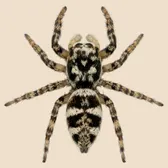
Has bold black and white banded legs and a zebra-striped abdomen with oblique white bands, unlike the plainer pale legs and mottled brown body of the female and gray-morph male dimorphic jumping spider.
Questions
Is the Dimorphic jumping spider dangerous to people?
This jumping spider is not known to bite people and simply hunts insects among vines and shrubs, where it can be watched safely up close.
When can you see the Dimorphic jumping spider?
The Dimorphic jumping spider can be seen from March to October, by day and at night.
Plate retouched from a photo by Justin Williams, CC BY 4.0, iNaturalist Licence
Report a mistake in this entry
Spiders›Jumping spiders›Maevia
Last updated 2026-09-27. Every entry is checked against published sources.