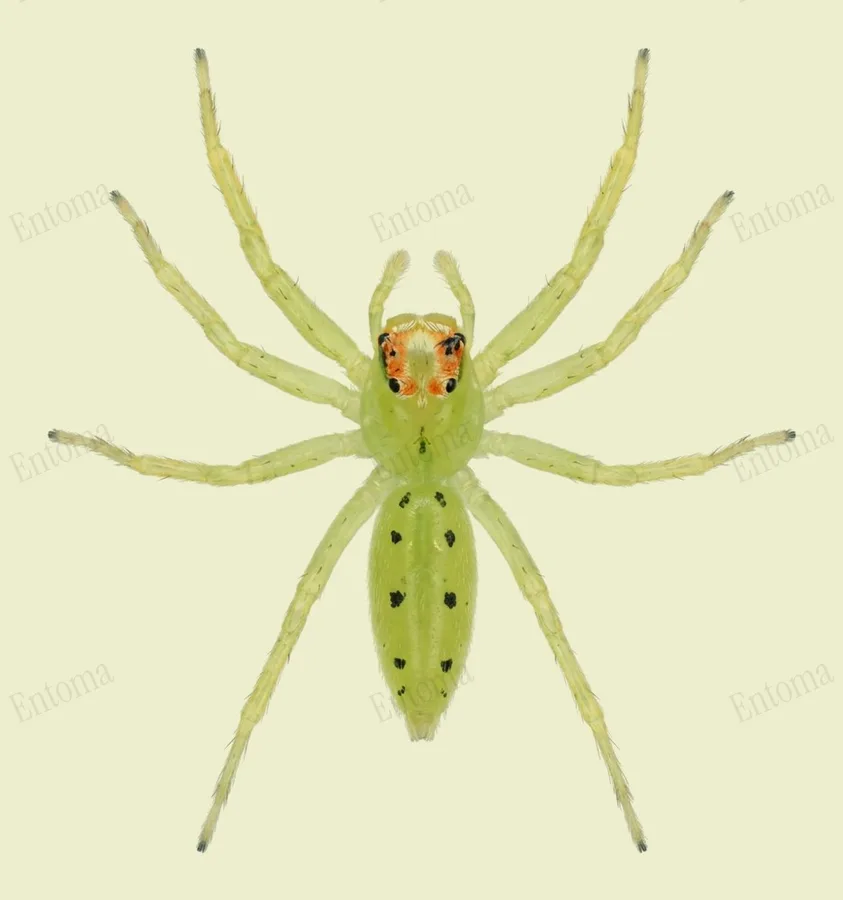
Magnolia green jumping spider
This spider is pale green and so thin its body looks translucent, with legs longer in proportion to its body than most jumping spiders.
| Where | Broadleaf forests in the southeastern United States |
|---|---|
| Size | Female 6 to 8 mm, male 5 to 6 mm body length |
| When | February to December |
The magnolia green jumping spider is small, pale and almost translucent green, with legs unusually long for a jumping spider. Males have brightly colored, enlarged chelicerae and forelegs used in courtship displays, while females are more muted in color.
It lives on the broad leaves of magnolia, oak, maple and pine trees in humid forests, hunting small plant-feeding insects by sight rather than with a web. It ranges across the southeastern United States, Texas and north to Maryland.
Traits
Habitat
Woodland
Colour
Green, Yellow
Active
Day and night
To people
Not dangerous to people; too small and unaggressive to pose any risk.
Activity through the year
Often confused with
Distinctly larger at 12 mm or more, with spiny legs and reddish chevron markings on the abdomen, unlike the small, plain, almost translucent magnolia green jumping spider.
Questions
Is the Magnolia green jumping spider dangerous to people?
Not dangerous to people; too small and unaggressive to pose any risk.
When can you see the Magnolia green jumping spider?
The Magnolia green jumping spider can be seen from February to December, by day and at night.
Plate retouched from a photo by glmory, CC0, iNaturalist Licence
Report a mistake in this entry
Spiders›Jumping spiders›Lyssomanes
Last updated 2026-09-27. Every entry is checked against published sources.