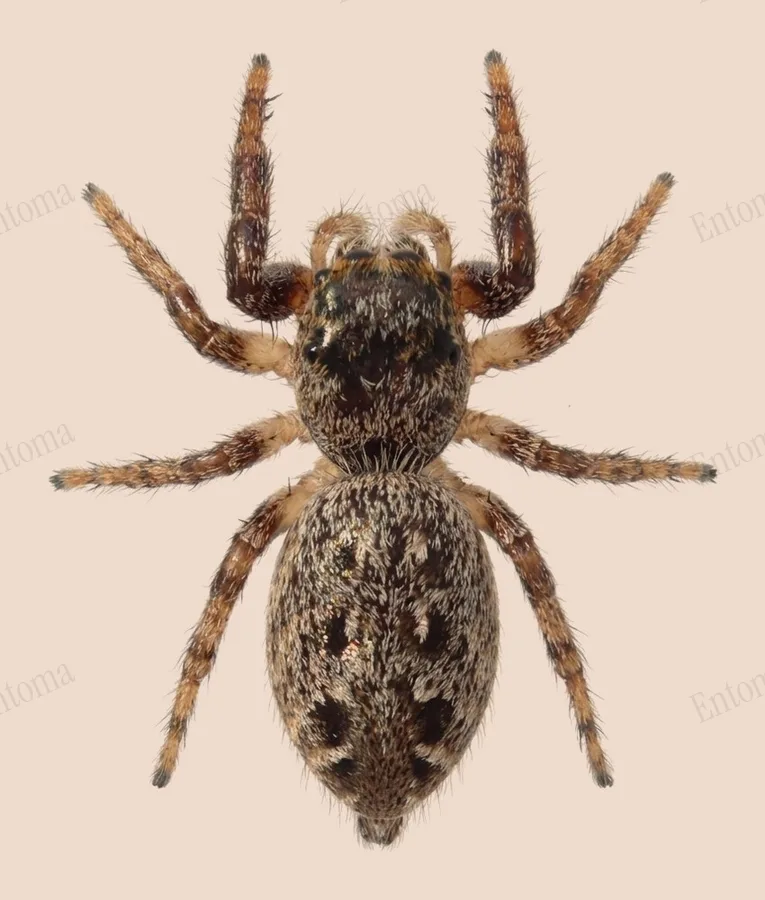
Bronze jumping spider
In direct sunlight this small spider's body flashes a metallic bronze or copper sheen, an effect created by dense, flattened hairs rather than pigment.
| Where | Shrubs, fields and building walls |
|---|---|
| Size | Female 6 to 8 mm, male 5 to 7 mm body length |
| When | March to October |
Dense, flattened hairs give this spider a bronze or copper iridescent sheen, most obvious in sunlight. Males have a dark brown carapace with white side stripes and an iridescent bronze abdomen ringed in white, while females are reddish brown above with four pairs of pale spots on a darker abdomen; females run 6 to 8 mm and males 5 to 7 mm.
It lives in sheltered vegetation around fields, orchards, woodland edges and homes, hunting small insects by sight during the day. In autumn it often turns up crawling on buildings and gathers with others under loose tree bark to spend the winter.
Traits
Habitat
Garden
Colour
Brown, White, Metallic
Active
Day
To people
This spider does not bite people under normal circumstances and is not dangerous; like other jumping spiders it may give a brief pinprick nip only if squeezed.
Activity through the year
Often confused with
Adult male bronze jumping spiders are larger and stockier with bigger, more forward projecting fangs, while male Pelegrina show more white scaling across the face.
Questions
Is the Bronze jumping spider dangerous to people?
This spider does not bite people under normal circumstances and is not dangerous; like other jumping spiders it may give a brief pinprick nip only if squeezed.
When can you see the Bronze jumping spider?
The Bronze jumping spider can be seen from March to October, by day.
Plate retouched from a photo by Ilona, CC BY‑SA 4.0, iNaturalist Licence
The plate on this page is shared under the same licence as its source, CC BY-SA.
Report a mistake in this entry
Last updated 2026-09-27. Every entry is checked against published sources.