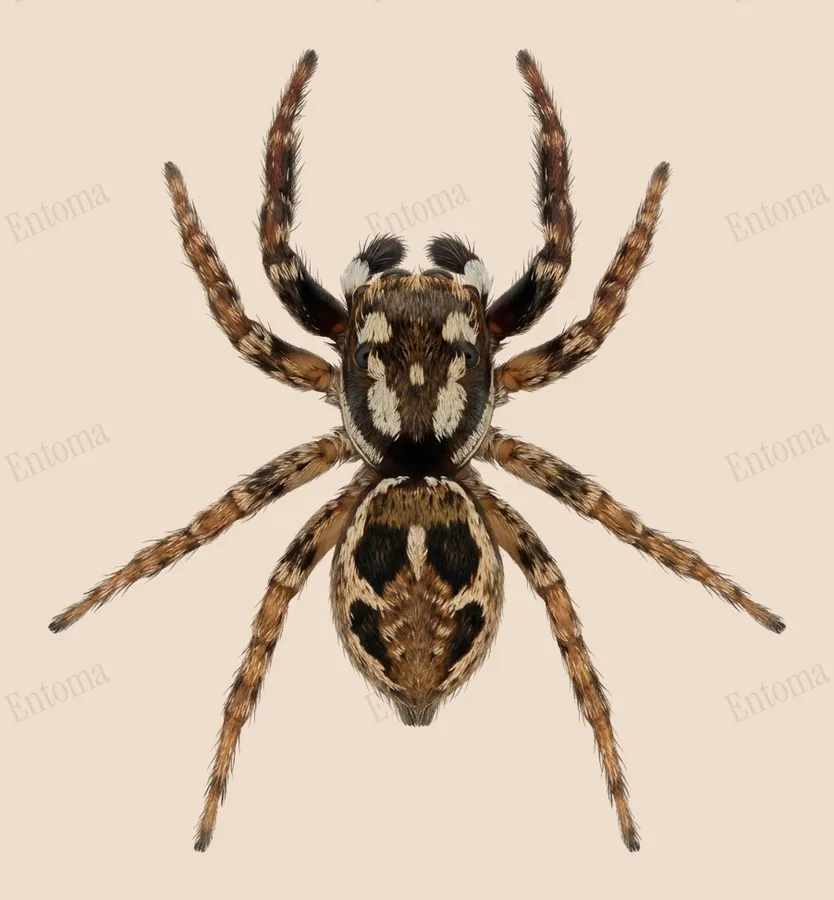
Twin-flagged jumping spider
Males of this tiny jumping spider court females with iridescent scales that can flash white, green or pink depending on the angle of light.
| Where | Leaf litter across the southeastern United States |
|---|---|
| Size | 4 to 7 mm body length |
| When | March to November |
The twin-flagged jumping spider is small and mostly brown or grey, named for two pale, flag-shaped markings along the sides of the abdomen. Iridescent scales around the eyes and on the male's pedipalps can appear white, green or pink depending on the light.
It hunts by day in leaf litter, on tree trunks and on the walls of buildings, relying on sharp eyesight to stalk small insects rather than spinning a web. It is most active in the early morning hours across the southeastern United States.
Traits
Habitat
Woodland
Colour
Brown, White
Active
Day
To people
Too small to bite through skin and not known to be aggressive toward people.
Activity through the year
Often confused with
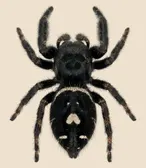
Much larger at 8 to 15 mm, with a single large white or orange spot in the center of the abdomen rather than the twin-flagged jumping spider's paired pale flag markings.
Questions
Is the Twin-flagged jumping spider dangerous to people?
Too small to bite through skin and not known to be aggressive toward people.
When can you see the Twin-flagged jumping spider?
The Twin-flagged jumping spider can be seen from March to November, by day.
Plate retouched from a photo by ncb1221, CC BY 4.0, iNaturalist Licence
Report a mistake in this entry
Spiders›Jumping spiders›Anasaitis
Last updated 2026-09-27. Every entry is checked against published sources.