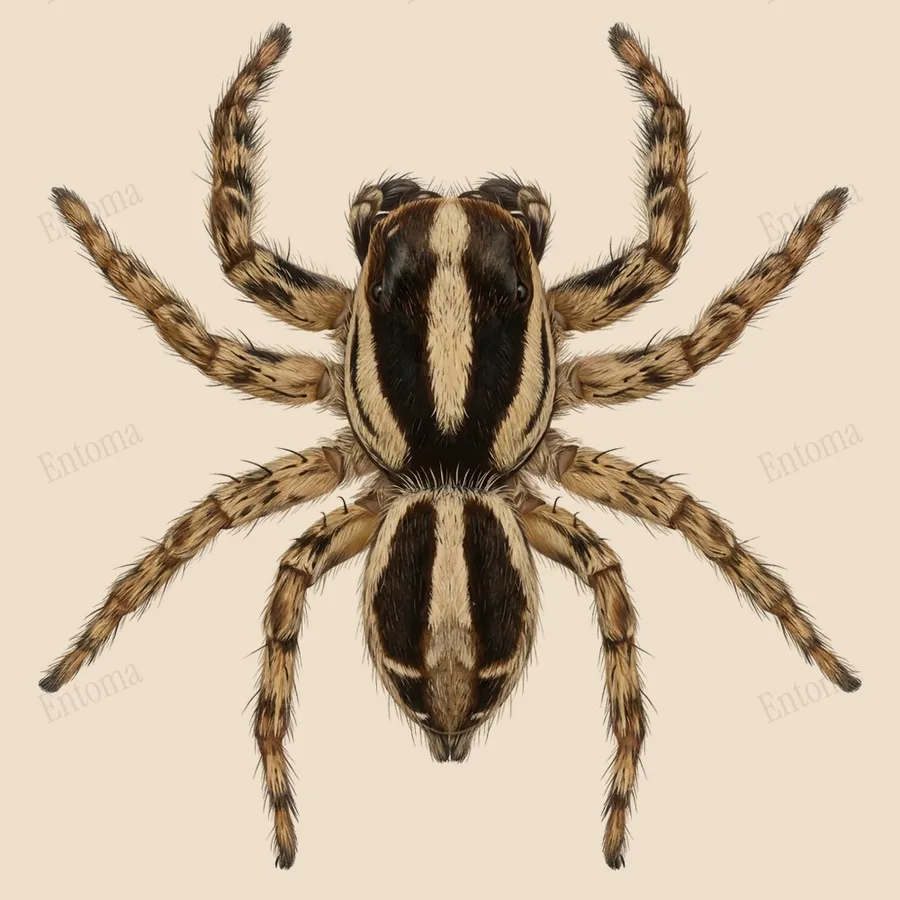
Pantropical jumping spider
Males and females of this jumping spider look so different that they are sometimes mistaken for two separate species, one black and white, one gray and brown.
| Where | Buildings and walls across East Asia |
|---|---|
| Size | Female 9 to 12 mm, male 7 to 9 mm body length |
| When | March to November |
Males have a black carapace and abdomen crossed by white stripes, while females are brownish gray with a tan stripe that breaks into a chevron pattern across the abdomen; both sexes have long legs and large forward facing eyes for judging distance before a jump.
It lives on and around buildings across East Asia, often waiting near outdoor lights at night to catch insects drawn to the glow, then stalking and leaping on prey by day as well.
Traits
Habitat
Towns
Colour
Black, White, Brown
Active
Day and night
To people
Not dangerous to people; bites are rare and happen only if the spider is handled or trapped against skin.
Activity through the year
Often confused with
This similarly building-dwelling relative has a brown cephalothorax with reddish bands and a brown-banded abdomen in both sexes, lacking the bold black-and-white stripes of male Plexippus paykulli.
Questions
Is the Pantropical jumping spider dangerous to people?
Not dangerous to people; bites are rare and happen only if the spider is handled or trapped against skin.
When can you see the Pantropical jumping spider?
The Pantropical jumping spider can be seen from March to November, by day and at night.
Plate retouched from a photo by Fidel, CC BY 4.0, iNaturalist Licence
Report a mistake in this entry
Spiders›Jumping spiders›Plexippus
Last updated 2026-09-27. Every entry is checked against published sources.