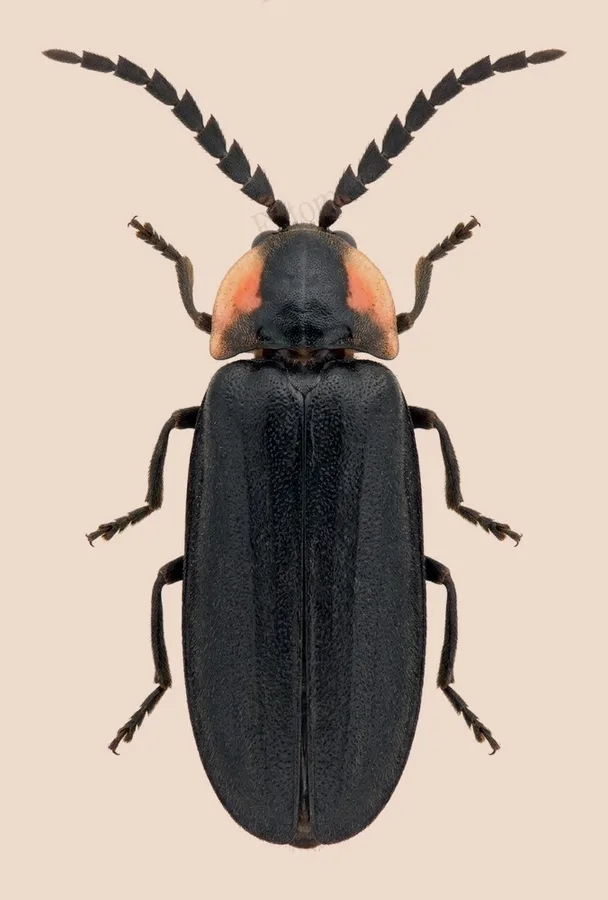
Black firefly
Despite its name, this beetle never flashes: it lost the ability to glow as an adult and instead finds mates with pheromones in broad daylight.
| Where | Shaded, moist woodlands in eastern North America |
|---|---|
| Size | 8 to 13 mm body length |
| When | May to July |
The Black firefly is a slender, dark beetle with black or brownish-black wing covers and a pronotum that is usually red or yellow with a black central stripe, though some individuals are dark overall. Unlike most fireflies, the adults do not produce light.
Adults fly low and slowly through shaded, moist woodlands in late morning and early afternoon, searching for mates by scent rather than by flashing. The bioluminescent larvae live in damp leaf litter and rotting wood, where they hunt snails, slugs and other soft-bodied invertebrates.
Traits
Habitat
Woodland
Colour
Black, Orange
Active
Day
To people
Harmless to people; adults do not bite, sting or produce light, and are active by day rather than at night.
Activity through the year
Often confused with
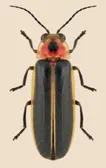
Overlapping in size at about 9 to 19 mm, but the Common eastern firefly is active at night and flashes yellow-green light in a J-shaped flight, with black wing covers edged in pale yellow, while the Black firefly flies by day, never flashes, and has plain black wing covers.
Questions
Is the Black firefly dangerous to people?
Harmless to people; adults do not bite, sting or produce light, and are active by day rather than at night.
When can you see the Black firefly?
The Black firefly can be seen from May to July, by day.
Plate retouched from a photo by Juvia Heuchert, CC BY 4.0, iNaturalist Licence
Report a mistake in this entry
Last updated 2026-09-27. Every entry is checked against published sources.