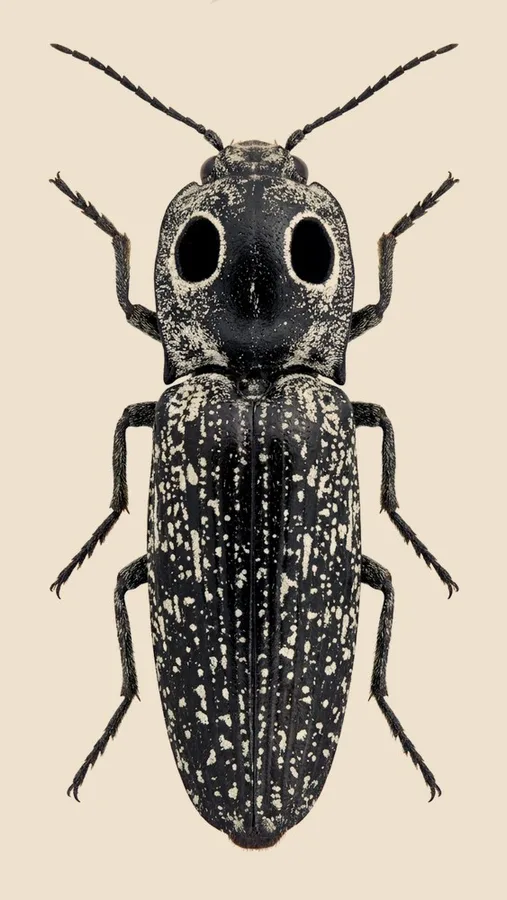
Eastern eyed click beetle
The Eastern Eyed Click Beetle can snap a hinge on its back to flip itself several inches into the air when placed upside down.
| Where | Deciduous forests with rotting logs |
|---|---|
| Size | 24 to 45 mm body length |
| When | April to August |
A pair of large, black false eyespots ringed in white cover much of the pronotum, making this mottled black-and-white beetle look far more alarming than it is. The real eyes are much smaller and sit near the antennae on the head.
Larvae live for a year or more inside rotting logs, hunting the grubs of other wood-boring beetles. When an adult lands on its back, a hinged joint between head and thorax lets it snap against the surface and flip itself upright with an audible click.
Traits
Habitat
Woodland
Colour
Black, White
Active
Day and night
To people
Harmless to people; adults sometimes fly to house lights but do not bite or sting.
Activity through the year
Often confused with
Eyespots are much smaller and less distinct, and the body is mostly slate gray, compared with the bold black-and-white eyespots of the Eastern Eyed Click Beetle.
Questions
Is the Eastern eyed click beetle dangerous to people?
Harmless to people; adults sometimes fly to house lights but do not bite or sting.
When can you see the Eastern eyed click beetle?
The Eastern eyed click beetle can be seen from April to August, by day and at night.
Plate retouched from a photo by Matt Berger, CC BY 4.0, iNaturalist Licence
Report a mistake in this entry
Last updated 2026-09-26. Every entry is checked against published sources.