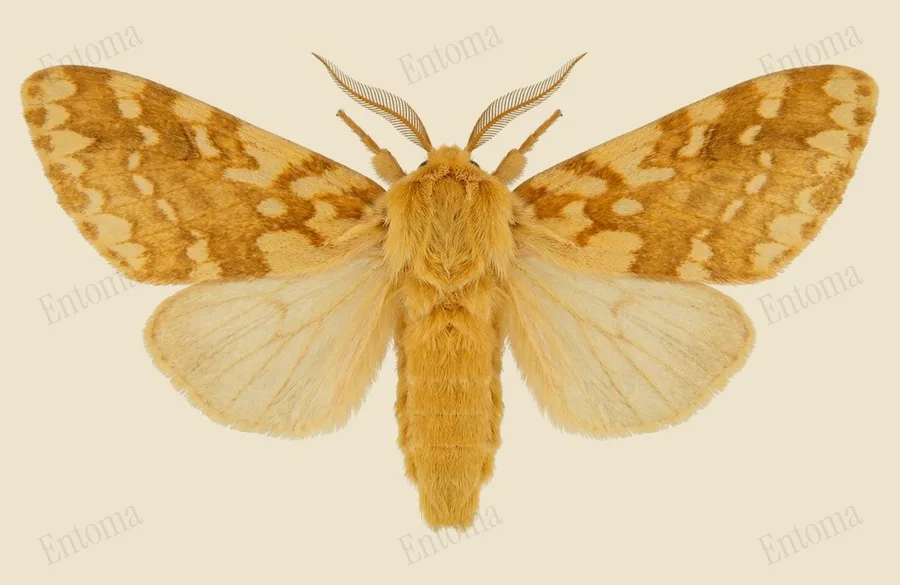
Spotted tussock moth
Spotted Tussock Moth caterpillars carry mild irritant hairs, and one documented case caused a child anaphylaxis after contact.
| Where | Deciduous forests with willows and poplars |
|---|---|
| Size | 20 to 45 mm wingspan |
| When | May to October |
The adult moth has tan to yellow forewings crossed by brown lines, a plain pattern easily overshadowed by its much showier caterpillar. That caterpillar carries a broad orange or yellow band around its middle with black hair tufts at both ends, each tipped with white.
Caterpillars feed on willows, poplars and several other broadleaf trees through late summer before spinning a cocoon that incorporates their own hairs for protection. Only one generation flies each year across most of the range, with adults on the wing from late spring into summer.
Traits
Habitat
Woodland
Colour
Yellow, Brown
Active
Night
To people
Mild
Handling the caterpillar can mildly irritate skin, and a rare anaphylactic reaction has been documented in a child.
Activity through the year
Often confused with
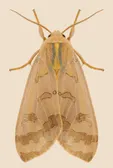
Caterpillar is gray to pale yellow-green with long black-and-white hair pencils at both ends, rather than the distinct orange or yellow mid-body band of the Spotted Tussock Moth caterpillar.
Questions
Is the Spotted tussock moth dangerous to people?
Mild. Handling the caterpillar can mildly irritate skin, and a rare anaphylactic reaction has been documented in a child.
When can you see the Spotted tussock moth?
The Spotted tussock moth can be seen from May to October, at night.
Plate retouched from a photo by Louis Imbeau, CC BY 4.0, iNaturalist Licence
Report a mistake in this entry
Butterflies and moths›Erebid moths›Lophocampa
Last updated 2026-09-26. Every entry is checked against published sources.