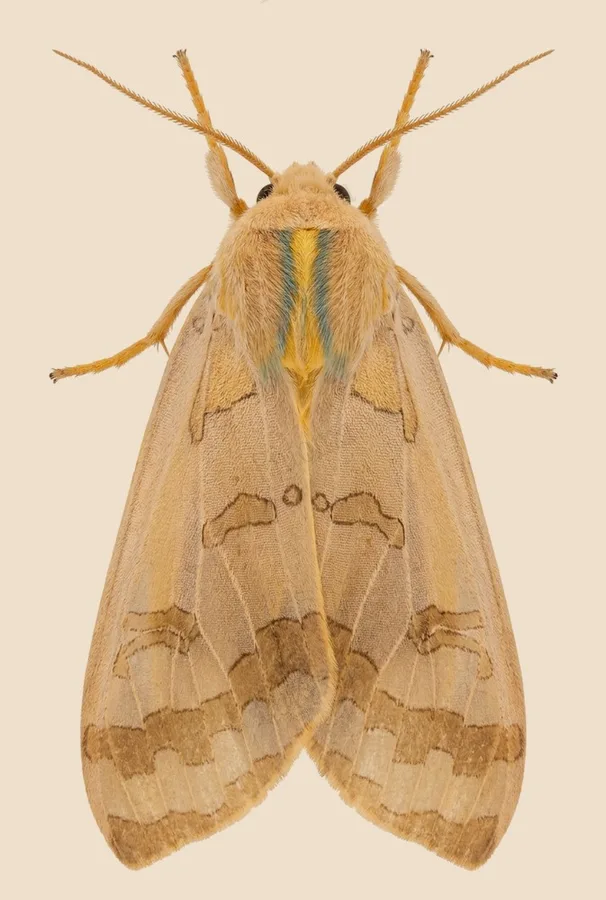
Banded tussock moth
Its caterpillar carries four long tufts of dark hair, two at the front and two at the back, that break off easily and can irritate skin on contact.
| Where | Woodlands, forests and gardens |
|---|---|
| Size | 38 to 51 mm wingspan |
| When | June to October |
The adult moth has pale tan to yellowish forewings with faint darker lines and a fuzzy yellow brown body, giving it a soft, plain appearance compared to more boldly marked tiger moths.
Caterpillars are covered in dense tan and white hairs with long black hair pencils at each end, and feed on the leaves of oak, birch, ash and other deciduous trees through summer and fall.
Traits
Habitat
Woodland
Colour
Yellow, Brown
Active
Night
To people
Mild
Adults are harmless, but the caterpillar's loose hairs can irritate skin and cause an itchy rash if handled.
Activity through the year
Often confused with
Caterpillar hairs form denser, more uniformly pale tufts along the body, without the long dark hair pencils projecting from the front and rear of the Banded tussock moth's larva.
Questions
Is the Banded tussock moth dangerous to people?
Mild. Adults are harmless, but the caterpillar's loose hairs can irritate skin and cause an itchy rash if handled.
When can you see the Banded tussock moth?
The Banded tussock moth can be seen from June to October, at night.
Plate retouched from a photo by ceeec, CC0, iNaturalist Licence
Report a mistake in this entry
Butterflies and moths›Erebid moths›Halysidota
Last updated 2026-09-26. Every entry is checked against published sources.