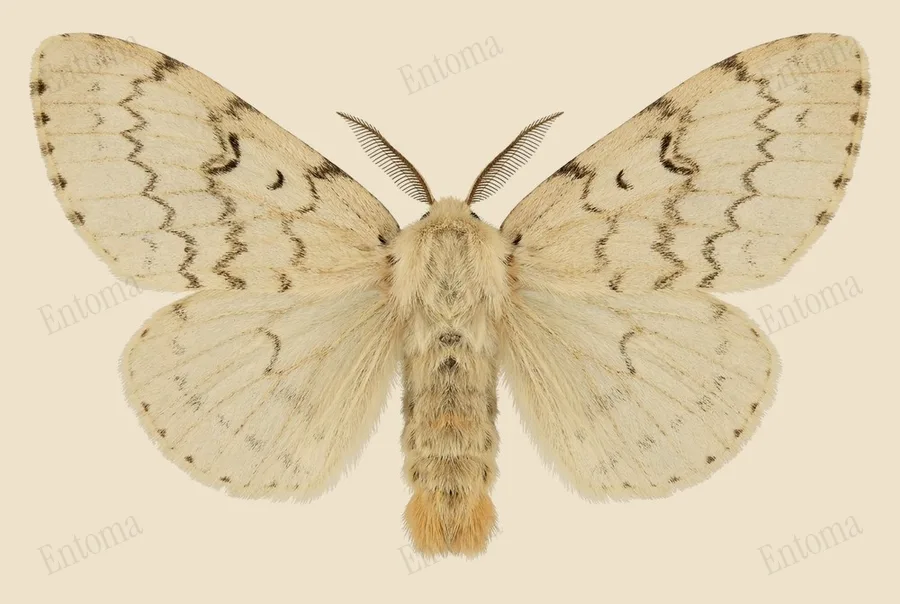
Spongy moth
Female spongy moths are so heavy bodied that they can barely fly, so males track them down by day using zig-zag flights guided by scent.
| Where | Deciduous woodland and parkland |
|---|---|
| Size | 32 to 55 mm wingspan |
| When | May to August |
The male is greyish brown with darker, jagged crosslines and a wingspan of around 32 to 40 mm, while the female is much larger, whitish with faint dark markings, and has a stout body that leaves her almost flightless.
Caterpillars are covered in tufts of bristly hairs and feed on a wide range of deciduous trees; those hairs can break off on contact and irritate skin, sometimes causing a rash in sensitive people.
Traits
Habitat
Woodland
Colour
Brown, Grey, White
Active
Day
To people
Mild
Caterpillar hairs can irritate skin
Activity through the year
Often confused with
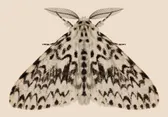
The black arches carries three black spots on the thorax that the spongy moth lacks, and is smaller overall with more sharply contrasting black and white barring.
Questions
Is the Spongy moth dangerous to people?
Mild. Caterpillar hairs can irritate skin.
When can you see the Spongy moth?
The Spongy moth can be seen from May to August, by day.
Plate retouched from a photo by Didier Descouens, CC BY‑SA 4.0, Wikimedia Commons Licence
The plate on this page is shared under the same licence as its source, CC BY-SA.
Report a mistake in this entry
Butterflies and moths›Erebid moths›Lymantria
Last updated 2026-09-26. Every entry is checked against published sources.